Bo Techniques, Forms, and Partner Practices of Ancient Okinawan Fighting Traditions. Volume 1: Bo-odori.
US $ 44
6″ x 9″ (15.24 x 22.86 cm)
XXXIV, 266 pages
ISBN: 979-8880149520
First Printing: 2024
Independently published.
Get the Discount! Dojo owners, association officials, retailers: Get discounts on bulk orders. I will have it shipped to you directly from your regional Amazon hub.
Qty
Discount %
5
6 %
10
7 %
20
10 %
50
15 %
100
16 %
Ancient bōjutsu, bō-odori, bō-furi, or village bō from Okinawa received much less attention than its famous sister discipline of kobudō. However, to really understand Okinawan martial arts in general, these old traditions are a mirror of the past we must not ignore. Representing a captivating realm of Okinawan culture, the ancient art of the bō takes center stage in a dazzling array of performances. From the graceful finesse of bōjutsu to the rhythmic energy of lion dance bō, the island proudly boasts a rich tapestry of traditions. Within the fabric of these performances lies a hidden world—the realm of “The Last Secrets of Okinawan Martial Arts with Weaponry.”
BTW, I began the study of Okinawan Bo-odori thirteen years ago, with the first results published here. Good things take time.
Sound effects in karate and kobudo are an underestimated part of the art of performance. The best known example of it is slapping the uniform (dogi) with the pull back hand (hiki-te) while executing a technique with the other hand. The typical suspects of dogi-slapping are karate practitioners in the field of competitive karate, particularly those specializing in kata. Dogi-slapping really wouldn’t make sense in kumite either. And it’s true, sometimes techniques performed in the air during kata don’t feel powerful, nor are they perceived as such by the spectators and judges. The sound effect produced by slapping the dogi is therefore a popular dramatic element of many kata performances, and there are true masters of this art.
But this alone is not the full story. There are also plosives produced by the chest and mouth, which are synchronized in time with the dogi-slapping. And in Okinawa karate there is also the boiler breathing of Goju-ryu and the hissing of Uechi-ryu. The sychronisation becomes more difficult then.
Another underestimated effect is the rustling and clicking of the dogi, which is caused by the cut of the uniform, by a certain execution of the movement and its trajectory, a certain material composition, by washing and drying and adding or omitting fabric softeners, etc.
Some schools preach the gliding of the feet, while others prefer stomping sounds as an expression of a certain dynamic, and there are hybrids that use both variants skilfully to create a certain acoustic drama synchronized with the movement.
Cleverly employed stomping sounds are difficult to detect, especially when the movements are short and small and the performer’s demeanor draws attention to the upper extremities and the face. This method is also found on the makiwara, where synchronization of makiwara strikes with stomping sounds give the impression of considerable dynamism and destructive power.
On the one hand, one could say that the targeted use of such acoustic elements mainly serves to give the impression of dynamics and to impress an audience or judges. Why else are none of these tricks found in kumite, such as Kuyokushin? In this case, stomping sounds would be one of several theatrical sound effects to be synchronized with each other and with the movement to create a maximum dynamic impression without each being overly noticeable individually.
But there is also the completely opposite argument, namely that all these sound effects are simply the result of a correct, powerful technique. In this case, stomping would be one of several sound effects generated as an accompaniment to a functionally correct execution of technique, and which are synchronous with each other and with the technique because they are a function of the technique.
So the whole thing is a “chicken-egg causality dilemma,” which is notoriously difficult to solve.
Some schools use the heel stomp as a functional support of their technique execution.
Such sound effects are mainly used in the area of kata demonstrations, but also on the makiwara, in kihon, shime testing and other practices. They are not only used by certain groups among karate athletes, but are also found as fundamental components in so-called “traditional karate” and Okinawa karate. All groups also have their own sets of theatrical sound effects, which are synchronized both with each other and with the movement to create an overall impression. In many cases, you can tell which group is involved based solely on the properties of the artificially generated sounds. This alone is reason enough to pay attention to this phenomenon.
A significant factor in stomping is the ground surface. Therefore, people who train or perform on mats will emphasize different stomping parameters than those who train or perform on wooden floors, which greatly amplifies the stomping sound effect. Sprung floor will even provide you a tiny acceleration while at the same time it reduces the stress on the joints. On the other hand, people who train or perform on natural surfaces such as grass, sand, or stone will employ completely different types of foot movement, since there is no sound effect whatsoever. So the question arises whether the different stomping sound effects are not simply a result of the development of different training sites. Just imagine stomping on pointed pebble, or a sharp-edged coral stone.
It should be borne in mind that in Okinawa, by and large, dojos with wooden floors were built only in the modern era after 1945. From this perspective, pushing the feet with the toes over the ground should also be a rather new method, which at least requires straight and flat grounds such as mats or a sports ground, and is difficult to carry out on natural, uneven surfaces, where it would simply make little sense. Thus, it may be assumed that the stomping sound effect as a theatrical element in Okinawan dojos is a post-war development and may have had little to no functional significance in original karate and kobudo, except maybe in the mansions of the aristocratic udun and tunchi classes.
Abstract: This article provides an overview of the lexical meaning, subject areas and chronology of usage, as well as the terminological origin of the term shingitai.
Research method: For bibliographic queries, I used the National Diet Library of Japan (one of the largest libraries in the world), Webcat Plus (a search service for books and papers operated by the National Institute of Informatics in Japan), and CiNii (a bibliographic database service for materials in Japanese academic libraries, maintained by the National Institute of Informatics). Moreover, I used the term base Kotobank, a service allowing to search for the meaning of a term from entries in highly reliable Japanese dictionaries, encyclopedias, and databases.
Result: As expected, shingitai is by no means an ancient Japanese martial arts concept, but rather a construction of contemporary Japan. Two isolated cases appear in the 1940s, but shingitai really took a foothold since the 1950s, mostly in sumo, but spread out quickly to judo and kendo, until in the mid-1990s the media adopted it for the Japanese budo in general. In 2008, shingitai was finally included in the very definition of Japanese budo by a semi-official institution. During these decades, shingitai has also spread to all kinds of sports as well as many other professional fields, as shown in this article.
Terminological Introduction
Western online dictionaries translate shingitai as “mind, technique, and physical strength,” and as the “three qualities of a martial artist or athlete: heart, technique, strength.” This is consistent with the literal translation and partly with the scope of use shingitai.
Certainly, the compound noun shingitai comprises of the following terms (on-reading in bold, followed by kun-reading):
shin / kokoro: mind
gi / waza: technique
tai / karada: body
Therefore, in its simplest interpretation, shingitai means “mind, technique, and body.” At the same time, it insinuates the unity or trinity of its three compartments. Shingitai is commonly used extactly this sense in sports to mean a “balance of mind, body, and spirit.”
In addition, shingitai is further defined as a general term representing the desired unity of the following three compartments:
mental strength (seishin-ryoku, i.e. shin),
technique / skill (gijutsu, i.e., gi), and
physical strength (tairyoku, i.e., tai).
Equating the above, shingitai refers to “mental strength, skill, and physical strength,” and implies the unity thereof as a goal.
The above description is the sole main entry of shingitai found in all Japanese dictionaries referred to in the Kotobank term base. In addition, shingitai does not have an individual entry as a term in Japanese Wikipedia. This raises the question of its actual distribution in general Japanese language.
In Japanese Wikipedia, shingitai as a term is found in the entries about the Grand Slam Paris 2011, Satō Nobuyuki (Japanese marathon runner), Iwai Joshiki (Japanese baseball player), Hayashi Toshiyuki (Japanese rugby union player), Akaiwa Yoshio (Japanese boat racer), TV-show “Juken Sentai Gekiranger” (Beast-Fist Squadron Gekiranger), Ogasawara Hiroshi (Japanese rugby player), Fuji Sankei Ladies Classic (Golf), Takahashi Miyuki (Japanese volleyball player), as well as in a very few budō-related entries such as about “Monthly Budō” magazine, henka (variation of technique) in sumō, and budō. In short, shingitai is used heavily in relation to various sports.
About swimming, the Encyclopedia of Japan (Nipponica) says, “Performance in sports is the combined result of technique (gijutsu), physical strength (tairyoku), and willpower (kiryoku). The basic elements necessary to improve swimming records are (1) the swimming style and the techniques for starting and turning, (2) physical strength, stamina, endurance, and (3) mental strength to support them. In addition, strategic elements such as setting the pace that make use of mind, technique, and body (shingitai) are also important in the game. In particular, the elements of mind, technique, and body (shingitai) are improved through daily training. The extent to which a player can improve these depends on their individual qualities, but it also depends on how well they incorporate training methods based on scientific theories according to the characteristics of the player.”
While the above article mentions shingitai in general terms, it also describes it specifically for improving swimming performance through training, namely
gi or technique as “(1) the swimming style and the techniques for starting and turning,”
tai or body as “(2) physical strength, stamina, endurance,” and
shin or mind as “(3) mental strength to support them.”
The same text also gives shin as “willpower” (kiryoku).
The Japanese version of Britannica International Encyclopedia has shingitai in its entry on jūdō, saying that randori “is a practice method in which mind, technique, and body (shingitai) are trained to develop the ability to adapt to the situation, and to learn how to compete. When Kanō Jigorō founded jūdō, he emphasized the simultaneous practice of training of the spirit, competition, and physical education.”
From this it could be said that shingitai is found in jūdō as follows: shin refers to the training of the spirit (shūshin), gi refers to techniques applied in competition (shōbu), and tai refers to physical education (taiiku).
From the above, the nuance of the meaning of shingitai slightly shifted to the following:
shin: mind, mental strength, willpower, spirit
gi: technique, skill, techniques applied in a competition
tai: body, physical strength, physical education
Appearance of the term Shingitai in Budō
(Note: Due to time constrictions, all titles are quick English translations without full bibliographic reference)
Sumō
The term shingitai appears as early as 1942, in a sumō periodical, mentioning the “spirit, technique, and body (shingitai) of the three highest sumō ranks and their plunging into the fight” (Sumō 7(5), 1942-05, p. 66). Elsewhere it is said that “The spirit, technique, and body (shingitai) are harmoniously integrated, and the dignity of a yokozuna naturally oozes out” (Jinbutsu Ōrai 1-8, August 1952). It is reported that one wrestler “showed remarkable strength in mind, technique, and body (shingitai)” (Sumō 3(7), 1954-05, p. 36) and that another, “although he was exceptional already, his mind, technique, and body (shingitai) gradually improved, and in 1934 he was promoted to ōzeki, and in 1937 he was promoted to the long-awaited yokozuna, competing with Tamanishiki and Musashiyama (Sumō 4(9), 1955-06 p. 82). It is also published as a manly topic elsewhere, such as can be seen in “Shingitai: The 57thYokozuna Mienoumi Tsuyoshi,” published in the Monthly Construction Report by the Ministry of Construction in June (1980, p. 4-5). In July 1964, Kosaka Hideji wrote a special feature called “When will Tochinoumi’s mind, technique, and body (shingitai) be completed?” (Sumō, 1964-7, p 41-47).
In the following decades shingitai appeared in countless sumō-related publications, of which following is just a selection. In 1971, Futagoyama Katsuji, the 45thyokozuna also known as Wakanohana Kanji I., published “Mind, technique, and body (shingitai),” followed three years later by his “Introduction to mind, technique, and body (shingitai nyūmon).”
In 1972, the “Battle of Mind, Technique, and Body (shingitai)” by Taihō Kōki, 48thsumō grand champion was published in the extra-large new year’s edition of “Foresight Economy” magazine, which shows how shingitai entered the world of management early by way of sumō. In 2011, former sumō wrestler Mainoumi Shuhei published “Contradictions in the Sumō-Ring: The Truth in the Chaos of Grand Sumō Wrestling,” published by Business Japan, 2011, one of the first business magazines of Japan.
“Mind, technique, and body (shingitai)” magazine was published by the Sumō Research Group since 1983, and in 2011 the 58thyokozuna Chiyonofuji Mitsugu, published “The Power of the Rope” at Baseball Magazine under his later name Kokonoe Mitsugu.
The above is a glimpse of the use of shingitai as used in sumō. In fact, sumō-related publications dominated the overall use of shingitai until the late 1970. It therefore seems that shingitai first and foremost developed and evolved within the sumō world, and it continued to be used uninterruptedly in the context of sumō until today. It can be assumed that the use of the term shingitai radiated out from sumō publications to other fields to a considerable extent.
Kendō
In relation to kendō, the concept is found in 1955, saying “In this way, the opponent’s mind, technique, and body (shingitai) will be overwhelmed and he will lose his head, and with my sword pointed right at his center, I pierce through him to win.” (Sasamori Junzō: Kendō. Ōbunsha Sports Series, 1955, p. 54).
More recent publications are “The Strongest Kendō” (2008), Koyama Masaki’s “Samurai Learning with Japanese Swords: The Most Easy-to-understand Iaido Bible for Modern People” (2008), or “Kendō Practice Menu 200: Strengthen your mind, technique, and body!” (2012) by Koda Gunhide, a 8thdan kyōshi and professor of Tsukuba University, and Yano Hiroshi, 8thdan hanshi and former professor of Kokushikan University, published “Kendō – A Message from a Teacher” (Physical Education and Sports Publishing, 2017).
Jūdō
In a 1950s jūdō course edited by Mifune Kyūzō and others, it is said, “It is desirable to come to demonstrate the power of unified mind, technique, and body (shingitai).” (Mifune Kyūzō et.al.: Jūdō Course, Vol. 1, 1955, p. 33). In a magazine published by the Kōdōkan is found a chapter called “About the mind, technique, and body (shingitai) of 30 athletes participating in international games” (Jūdō 50 (11). Kōdōkan, November 1979, p. 17-23). In 1982, Yamashita Yasuhiro, one of Japan’s most successful jūdōka and 8thdan holder published “The Judo World’s No. 1! Yamashita 5th Dan’s mind, technique and body (shingitai).” Gold medalist of the 2000 Olympics and Japanese jūdō coach Inoue Kōsei provided “Strengthen your mind, techniques, and body (shingitai)! Judo basics and practice menu” in 2013.
Karate
In karate apparently shingitai appeared for the first time in 1952, when Konishi Yasuhiro mentions that, “a kiai will promote the unification of the trinity of spirit, technique, and body (shingitai), so as to occupy an undefeatable position” (Konishi Yasuhiro: Zukai Karate Nyūmon, 1952, p. 11). In 1956, again by Konishi Yashuhiro, the following words can be said to establish shingitai as a part of an ideal form of karate: “In other words, karate practitioners should pursue the trinity of mind, technique, and body (shingitai).” (Konishi Yasuhiro: Karate jōtatsu-hō. 1956, p. 10).
However, in karate literature, it wasn’t emphasized much, until, in 1990, we find shingitai in karate again “for those who aim to improve their mind, technique, and body” (Shiroishi Shōji: Karatedō kyōgi nyūmon. Baseball Magazine Publishers, 1990). This is followed by Hokama Tetsuhiro’s “The Essence of Okinawa Karate and Kobudō” (1999), where it appeared in the context of Okinawa karate and kobudō. Kyokushin adopted shingitai as well, as can be seen in “Karate revolutionary Hamai Noriyasu – Kyokushin’s New Theory” of 2009, followed by shingitai used in “Kuro Obi: Aim for an invincible black belt!” published by BAB Japan in 2011. Ushirō Kenji, who teaches karate worldwide, also published “Learn how to train your mind, technique and body (shingitai) from Ushirō Kenji” in 2011. While these are just examples, it is true that the number of karate books that feature shingitai are small, particularly when compared to sumō.
Aikidō
Shioda Yasuhisa, third Sōke of Yoshinkan Aikidō, wrote “50 Tips for Improving Aikidō: Master your mind, technique, and body (shingitai)!” in 2008, but otherwise the use of shingitai in aikidō seems rare, at least in publications, which is also true for kyūdō, for which at least “Modern Kyūdō Course, Volume 5” (1969) could be verified.
Book of Five Rings
An edition of the “Book of Five Rings” (1980) includes the chapter “Miyamoto Musashi’s mind, technique, and body (shingitai),” and editions by other authors from 1996 and 2002 again include a reference to shingitai.
Ninjutsu
By the 2010s, (shingitai) has entered the world of the ninja, with Kuroi Hiromitsu’s “Ninja Cram School: Mind, Technique, and Body (shingitai) learned from Ninja (2011), Kawakami Jin’ichi’s “Ninja: From the Origins to Ninjutsu and Weapons: Approach the Truth of the Army of Darkness!” (2012), and Komori Teruhisa’s “The Secret of the Ninja’s Unbeatable Spirit” (2017).
Budō as a whole
In any case, the time when shingitai began to not only be associated with individual Japanese arts, but formally entered the Japanese budō world en gros, was when the Nippon Budokan began to publish the magazine Gekkan Budō (Monthly Budō). While the first version of it which ran from 1974 to 1996, had no direct reference to shingitai, in 1997, an additional title was added, namely “Comprehensive magazine that nurtures mind, technique, and body (shingitai).” This was the point in time when the connection between budō and shingitai became quasi official.
A little more than 10 years later, shingitai found its way into the definition of the “Foundational Principles of Budō” (budō no rinen) by the Japanese Budō Association (Nippon Budō Kyōgikai) as follows.
Budō is an exercise culture that unifies mind and technique (shingi ichinyo) that is based on the training of martial techniques systematized in Japan, and it originates from the tradition of bushidō. By practising jūdō, kendō, kyūdō, sumō, karatedō, aikidō, Shōrinji kenpō, naginata, and jūkendō, it is a path to forge mind, technique, and body (shingitai) in unity, to refine one’s character, to raise one’s moral sense, to cultivate an attitude of respect for propriety, and to contribute to peace and prosperity of nation and society.
Established October 10, 2008
Japanese Budō Association (Nippon Budō Kyōgikai)
Kata-Theory
In 1989, historian Minamoto Ryōen wrote a work called “Kata” 型, asking “What is the ultimate kata – the unity of mind, technique, and body (shingitai) – that physical action aims for?” In this, he equates kata with the unity of mind, technique, and body, that is, shingitai. Chapter 2 is called “Thoughts on Body, Mind and Technique in Prehistory, Antiquity, and the Middle Ages.” From old texts of nō drama and kenjutusu, Minamoto traces the spiritual history of “kata.”
However, it seems to be an attempt to backdate shingitai as a concept existing since the origin of the Japanese nation.
Appearance of the term Shingitai in other contexts
Shingitai does only appear in budō, quite on the contraty. Below are publications from various other contexts and fields which also include shingitai.
Western sports
Moreover, early on shingitai was also heavily used in connection with Western sports, as can be seen in in a 1952 baseball magazine, which writes that, “A good man who never gives up, trains his mind, technique, and body (shingitai), respects himself, and eventually gains recognition from the world.”( Baseball Magazine. 1952, p. 36), and it is also mentioned in relation to table tennis (Nippon University, 1956-05, p. 24). Another example is the description that “a good strike comes out when a good hitter has the heart, technique, and body strength (shingitai),” (Baseball Magazine Vol.1, 11(1), 1956-01, p. 132). In 1962, Yaoita Hiroshi, co-founder of Yasaka Table Tennis Equipment, published “Table Tennis” (Takkyū), with chapter 2 emphasizing “The Unity of Mind, Technique, and Body (shingitai).” More recently, former professional baseball pitcher Takashi Saitō published “The magic spell of Mind, Technique, and Body that will definitely work!” in the “Whonk and One Blow”-Series, Vol. 9, 2005, and there are guidebooks such as “Mental Training for Baseball Players: Change your mindset, improve your concentration, and win!” (2008)
Hasegawa Shigetoshi, retired relief pitcher in Major League Baseball, best-selling author and Japanese television personality, published “Winning a Major: The Mind, Technique, and Body of Japanese Pitchers” (2011), while Tezuka Kazushi wrote “Batting Strategy Theory: Raise your batting average and aim for long hits” (2012). Tatsunami Kazuyoshi and Nomura Hiroki wrote “The secret to improving baseball with parents and children: Hints for success, mind, technique, and professional thinking that everyone can learn” (2022) and Iwai Seiku publishd “Iwai-style Hard Baseball. The royal road method to hone your mind, technique, and body” (2018).
Besides there is Andō Misako’s “You can win the game! Softball’s strongest tactics” (2012), Kawagoe Shinsuke’s “You can win the game! Futsal’s 50 strongest tactics (2013), and Hasegawa Tarō’s “How to prepare mind, technique and body (shingitai) to mass-produce goals in soccer” (2017).
All of the above address shingitai.
Management, Business, Guidebooks
Another interesting field using shingitai is that of industrial management, leadership, sales, business self-help literature and guidebooks. In a continuous series in an industrial management magazine, Hirano Hiroyuki introuces “MRP (Material Requirements Planning) for small and medium-sized manufacturers,” saying that “You can also create a MRP’s mind, technique, and body (shingitai) production schedule” (In: Factory Management 27(10)(346), 1981-09, p. 101-110), and Mito Kiyoshi wrote “Aiming to be a technician with a good balance of mind, technique, and body (shingitai)” (In: Skills and Techniques. Technical Journal for the Development of Vocational Ability (5)(204), 2000, p. 9-15, published by the Vocational Training College of the Employment Promotion Agency). Shingitai is found in “The Exploding Solar Cell Industry: Current Status and Future of the 25 Trillion Yen Market” (2008) as wel as in Shimane Masamitsu’s and Shimizu Toshiyuki’s “Mind, Technique, and Body (shingitai) for Entrepreneurship: Steps to an Innovative Way of Life” (2018).
Also, in case you didn’t know it, there are “77 Laws of employees who continue to be selected: There is a trick to getting promoted quickly!” (2009). You also might be interested in “Skillful business succession of a small company: For a rich life plan after retirement” (2009), “The Power of Capable Rookie Leaders: How Modern Newcomers Acquire Mind, Techniques, and Body Forms (2010), the “Aesthetics of the Bartender: The Tavern Equation” (2010) or “Nikaido Shigeto’s Golden Rules of Successful Trading: The Secrets of Making Stocks and Forex (2011).
Whether you’re looking for “A chairmans’s accounting that changes management in one hour” as a “Prescription to prevent cash flow bankruptcy” (2010), “Heart Voice – Talk Techniques for Tele Appointment Sales” (2011), or “An introduction to the mind, technique, and body (shingitai) of sexy women” – it is all there.
You might also consult “Shin-Gi-Tai in the U.S. and Japan as Seen in Data” (Commerce and Industry Journal 23 (6), pp. 40-41, 1997-06), “Build better homes organically” (2013), or “How to create your best self” (2013) by the Japan Management Association Management Center – shingitai is in it, and there are countless more beyond the following short selection.
Matsui Hideki: 100% Thinking that Breaks Down Walls. PHP Lab, 2011.
Yamamoto Kazutaka: MBA Thinking and Writing Techniques: The heart and technique of business documents. Toyo Keizai Shimposha, 2011.
Sakaue Hitoshi; Ogasawara Koji: The Esay Guide to Start Your Own Company in Japan. Medium, 2011.
Kitakage Yuyuki: Samurai Athlete Soul: Mind, Techniques, and Techniques Learned from Hagakure: A Must-Read for Leaders! Study Hard, 2012.
Komori Osamu: Kaizen Leader Training School. Nikkan Kogyo Shimbun, 2012.
Mori Shigekazu: The Power to Keep Winning: Morishige-style Staff Studies to Nurture a Tenacious Organization. Business Company, 2012.
The Complete Guide to Work Experience 34. Poplar Company, 2013.
Darjeeling Himalayan Railway – ‘Moving World Heritage’ at the Roof of the World in India. Kodansha, 2006.
Moritomo Sadao: Intellect and mind, technique, and body in quality manufacturing. Journal of the Japan Society for Precision Engineering 63 (2), pp. 158-161, 1997.
Sugashita Kiyohiro: How to Ride Your Life on the Uptrend. Best Sellers, 2013.
Matsuoka Shuzo: Repair manager – Head of Repair Department. Takarajimasha, 2017.
Uchiyama Hiroyuki: Mind, technique, and body to improve performance: The path to successful sales activities. The New Japan Insurance Company, 2002.
Shimane Masamitsu, Shimizu Toshiyuki; Ariyoshi Tokuhiro: Mind, Technique, and Body for Entrepreneurship: Steps to an Innovative Way of Life. Izumi Bundo, 2018.
Hirokawa Keisuke; Asayama Noboru et.al.: Mind, technique, and body of a project manager who does not fail in system introduction: Awareness for sustainable growth. Seiunsha, 2019.
Vocational
Already in 1943 shingitai appears in a periodical of the Japan Handicraft Research Association in connection with occupational training, so it seems that the concept reached into various fields, such as can be seen in the “New Electricity” periodal, which states, “In order to maintain superiority at all times, it is necessary to demonstrate the unity of shin, gi, and tai to the highest degree” (New Electricity. Ohm Publishing, 1957-01, p. 70), and it might also be seen in connection with company sports teams, transcending the boundary to the vocational world.
Board Games
Alread in the 1960s, shingitai is found in conncetion with board games, as can be seen in “Victory: Go and Guts” (1965) by Sakata Eio, 9thdan professional go player, which has a section called “Mind – Technique – Body (shingitai).” Makoto Nakahara, a former professional shogi player who had gained the rank of a 9thdan, wrote about “How to carry out self-development. ‘Match’ with comprehensive power of mind, technique, and body (shingitai),” published by the “Management Consultant,” 1973-5, p. 96-97.
Medical Science and Sports Psychology
In “A Medical Approach to Anthropology” (1989), Chapter 7 covers an “Approach to a Four-Dimensional Human Image from Mind, Technique, and Body (shingitai)” and 1997 saw “The SOP theory that made 21-year-old Tiger Woods who likes ‘hamburgers’ and ‘to win’ approach the mind, technique, and body (shingitai)” (Gendai 31 (12), pp. 186-193, 1997-12), while Kakegawa Akio wrote “A Surgeon’s Mental Attitude. Maintaining and Improving the Balance of Mind, Technique and Body (shingitai) will bring Good Results” (In: Surgery 63 (1), pp. 73-74, 2001-01-01). The 2010s saw the puclications such as Kodama Mitsuo’s “ATop Athlete’s Quote from Poor Life Theory” (2012), “Mind, technique, and body (shingitai) in academic drug discovery” (Kanazawa University Cancer Research Institute, 2013), “Marathon Sense and Running IQ” by Hosono Fumiaki (2018), and Sakurai Shoichi’s “Requirements for Gold Medalists: How to create top-notch mind, technique, and body (shingitai)” (2020). Reaching the 2020s, there is Miyaji Shigeru’s “New Cerebral Endovascular Therapy Book: 68 Moves of Miyaji-style Mind, Technique, and Body (shingitai)” (Medica, 2022).
Novels
Shingitai began to appear in novels, such as can be seen in “Since ancient times, this has been called mind, technique, and body (shingitai). Without these three things, you cannot become a full-fledged swordsman!” (Nakayama Mitsuyoshi: Tamiya Bōtarō, 1956, p. 72).
Music
Shingitai also found its way into music, such as in an introduction to “mind, technique and body of Katsumi Hagiya’s trombone playing” (Pipers, 1981-12, p. 34-39), or “Research on music expression using musical instruments (3). Prospects for wind and percussion activities in school education” (Bulletin of Tomakomai Komazawa University (3) pp. 1-19, 2000-03).
Takada Saburō provided a “Daily Training Book for Singing Higher” (2008), while Ayame Yoshinobu asks, “Is it possible to play in an ensemble today?” (Tokyo Metropolitan Foundation for History and Culture Arts Council Tokyo, 2020).
Education
Finally, in 1984, shingitai appears in the educational context (Educational Perspectives 30(2)(320), 1984), and ten years later in Physical Education (42(14), 1994), published by the Japan Sports Instructors Federation, including a special feature on “Sports and Mental Training” with research by Endō Takurō (“Human Mind and Body”) and Egawa Kinsei (“The Mind, Technique, and Body that Determines Competition Results”). The latter, Egawa Kinsei, already published “Conditions for Victory: Mental Training for Sportsmen” in 1986, which also includes references to shingitai.
There is the “Mind, technique, and body (shingitai) in English class” (2009), and Takano Michi’s “Thinking about Coaching: From the Perspective of Active Players” (Annual Meeting of Japan Society of Physical Education 44B (0), 1993), or Sato Hisao’s “Ordinary children became the best in Japan! Sendai High School’s Mind, Technique, and Body (shingitai)” (2001). And of course, as Saito Takashi saiud, “This will make school more fun” (2011).
In Germany, there is the series “Geist-Technik-Körper (shingitai): Writings on the background of Budo-Arts,” with the “History of Japanese Martial Arts” (1996), “Budō in today’s time” (1998), “Tobi-ishi: Stepping stones of a karate path: Experiences, experiences and reflections from four decades of karate practice” (2007), and others.
Various
Coaching and self-help publications feature shingitai, such as “Self-Coaching Learned from Ichiro’s Words: The 99.99 Law for Living Yourself” (2008). There is also the outdoor world with “Fishing Romance: What Fishing Taught Me” (2011) and hentai, such as “One Piece Nippon Longitudinal! 47 Cruise CD 42 (in Nagasaki Hentai – Franky goes to Nagasaki) (2015).
Politics and Administration
In 2020, Kawai Toshikazu described “Mind, technique, and body (shingitai) to fulfill the city hall staff,” and there are the “Prospects for Democratic Judiciary: Shinomiya’s 70th Anniversary Commemorative Papers: Expectations for the Citizens as a Governing Body” (2022).
Academic Research
Also in the field of academic publications, one instance of shingitai can be seen in the 1950s, saying “If the mind, technique and body (shingitai) are not united, good results cannot be achieved” (Nihon University 1(1), 1956-05, p. 24). However, in academic discourse, shingitai appeared rather late. A keyword search at Waseda University Repository shows that shingitai as an academic topic only appeared since 2004. The earliest result found at through a query at the University of Tokyo Library OPAC System is from 1998, namely “The Science of Thoroughbreds: The Mind, Techniques, and Body of Racehorses” by the Japan Central Racehorse Research Institute and published by Kodansha in 1998. This again raises the question of how much shingitai was actually and formally used in general or technical languages. Particularly in science and academics, the reason might be that it is already an outdated concept for most disciplines, particularly in medicine, psychology, neuroscience and the like.
The book “My Art and Skill of Karate” presents the technical knowledge and original accounts imparted by famed Okinawa karate master Motobu Chōki (1870-1944). This translation was created in close cooperation with the author’s grandson, Motobu Naoki sensei. It also includes a congratulatory address by the author’s son, Motobu Chōsei sensei, the current head of the school. Moreover, this year marks the 150th anniversary of Motobu Chōki’s birth. In other words, three generations of the Motobu family were involved in this new translation, connecting the history and tradition of karate from the 19th to 21th century.
(Note: The Kindle version does not include the glossary index and only a rudimentary TOC, so navigation is less reader-friendly than in the print version)
In addition to accounts about old-time karate masters in Okinawa, the work features thirty-four photos of Motobu performing Naihanchi Shodan, including written descriptions. Moreover, it includes twenty kumite with pictures and descriptions as well as five pictures of how to use the makiwara.
What makes it even more unique is that the existence of the book was unknown until the 1980s, when the wife of a deceased student sent the book to Motobu Chōki’s son, Chōsei. Until today this edition remains the only known original edition in existence, and it provided the basis for this original translation. This work has to be considered one of the most important sources to assess and interpret karate.
Motobu Chōki: “My Art and Skill of Karate” (2020)
My Art and Skill of Karate (Ryukyu Bugei Book 3), by Choki Motobu (Author), Andreas Quast (Tr./Ed.), Motobu Naoki (Tr.)
Troubled about the future of his only son and heir, a royal government official of the Ryukyu Kingdom wrote down his ‘Instructions’ as a code of practice for all affairs. Written in flowing, elegant Japanese, he refers to a wide spectrum of artistic accomplishments that the royal government officials were ought to study in those days, such as court etiquette, literature and poetry, music, calligraphy, the tea ceremony and so on.
The author, who achieved a remarkable skill level in wielding both the pen and the sword, also informs us about various martial arts practiced in those days. Translated from Japanese for the first time, from centuries-long puzzling seclusion the state of affairs surrounding an 18th century Okinawan samurai vividly resurrects in what is considered ‘Okinawa’s most distinguished literature.’
Okinawan Samurai — The Instructions of a Royal Official to his Only Son. By Aka/Ōta Pēchin Chokushiki (auth.), Andreas Quast (ed./transl.), Motobu Naoki (transl.).
5″ x 8″ (12.7 x 20.32 cm)
Black & White on Cream paper
218 pages
First Printing: 2018
ISBN-13: 978-1985331037
ISBN-10: 1985331039
Translated from Japanese for the first time!
“I think it is epoch-making that Quast sensei decided to translate the ‘Testament of Aka Pēchin Chokushiki,’ and not one of the famous historical or literary works such as the Chūzan Seikan or the Omoro Sōshi. … I believe this translation has significant implications for the future study of karate history and Ryūkyū history abroad. (Motobu Naoki, Shihan of the Motobu-ryū)
“It is one of THE most important primary sources for truly understanding the unabridged history of our arts first hand by a member of the very class of people who spawned Karate in the first place!” (Joe Swift, Karateologist, Tokyo-based)
“I highly recommend this new work by Andi Quast … as a MUST BUY book …” (Patrick McCarthy, foremost western authority of Okinawan martial arts, modern and antique, anywhere he roams)
“I’m sure I’m going to learn and enjoy this book.” (Itzik Cohen, karate and kobudo man from Israel)
In the era of Old Ryukyu, a legendary warrior of Okinawan martial arts appeared on the center stage of the historical theatre. Due to his unique appearance and powerful physique—reminiscent of a wolf or a tiger—the people of that time called him Oni Ōshiro, or «Ōshiro the Demon.»
Also known as Uni Ufugushiku in the Okinawan pronunciation of his name, he had been variously described as the originator of the original Okinawan martial art «Ti» as well as the actual ancestor of a number of famous Okinawan karate masters, such as Mabuni Kenwa and others.
This is his narrative. Gleaned from the few primary sources available, which for the first time are presented here in the English language, the original heroic flavor of the source texts was kept intact.
«I invoke the Gods, To quake heaven and earth, To let the firmament resound, And to rescue the divine woman—Momoto Fumiagari.»
5″ x 8″(12.7 x 20.32 cm)
Black & White on Cream paper
94 pages ISBN-13: 978-1533486219 (CreateSpace-Assigned) ISBN-10: 1533486212 BISAC: Sports & Recreation / Martial Arts & Self-Defense
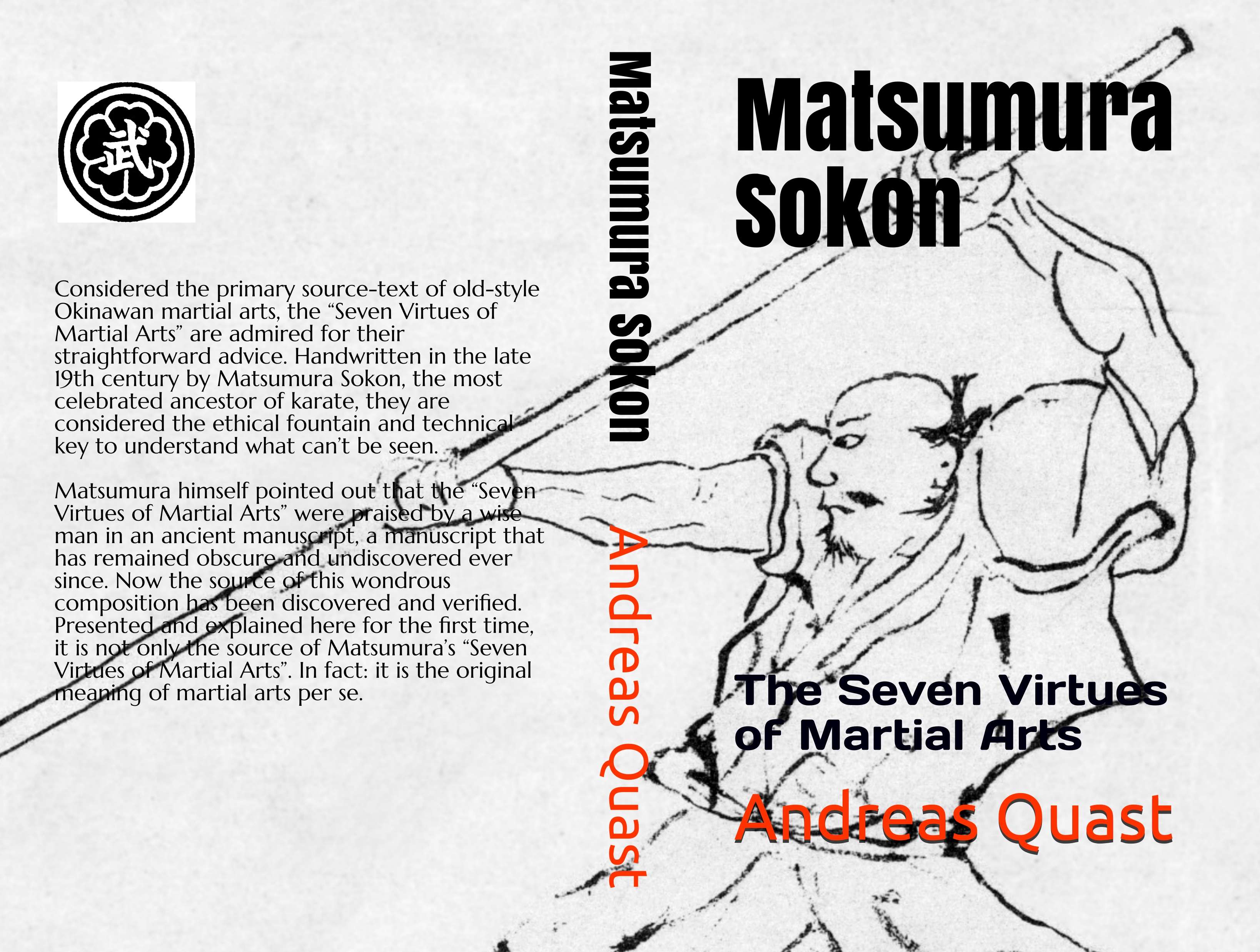
This is the true story of the seven virtues of martial arts as described by Matsumura Sokon. Considered the primary source-text of old-style Okinawan martial arts, the “Seven Virtues” are admired for their straightforward advice. Handwritten in the late 19th century by Matsumura, the most celebrated ancestor of karate, they are considered the ethical fountain and technical key to understand what can’t be seen.
This work includes the rare photograph of the original handwritten scroll, approved by the Okinawa Prefectural Museum & Art Museum as well as the owner of the scroll. It also shows the family crest of the Matsumura family, sporting the character of “Bu.”
Matsumura himself pointed out that the “Seven Virtues of Martial Arts” were praised by a wise man in an ancient manuscript, a manuscript that has remained obscure ever since. Now the ultimate source of this wondrous composition has been discovered and verified. Presented and explained here for the first time, it is not only the source of Matsumura’s “Seven Virtues of Martial Arts”… In fact, it is the original meaning of martial arts per se.
5″ x 8″(12.7 x 20.32 cm)
Black & White on Cream paper
80 pages
ISBN-13: 979-8605143611
BISAC: Sports & Recreation / Martial Arts & Self-Defense
Matsumura Sokon: The Seven Virtues of Martial Arts. By Andreas Quast, 2020.
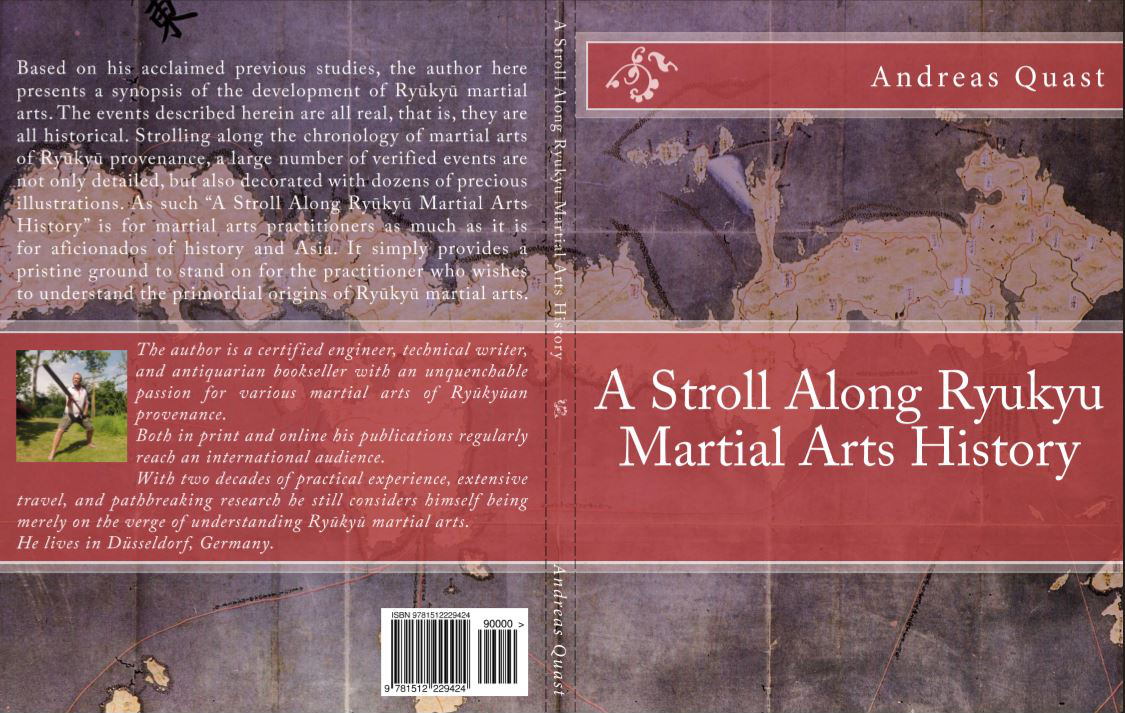
A Stroll Along Ryukyu Martial Arts HistoryPaperback– May 15, 2015
by Andreas Quast (Author)
Paperback edition: available at Amazon US ($14.99), Amazon UK (£9.79), Amazon Germany (EUR 14.97), CreateSpace eStore ($14.99), and at online and offline bookstores and retailers, as well as via public libraries and libraries at other academic institutions.
Based on his acclaimed previous studies, the author here presents a synopsis of the development of Ryukyu martial arts. The events described herein are all real, that is, they are all historical. Strolling along the chronology of martial arts of Ryukyu provenance, a large number of verified events are not only detailed, but also decorated with dozens of precious illustrations. As such “A Stroll Along Ryukyu Martial Arts History” is for martial arts practitioners as much as it is for aficionados of history and Asia. It simply provides a pristine ground to stand on for the practitioner who wishes to understand the primordial origins of Ryukyu martial arts.
For those who read “Karate 1.0”: this new book here is a synopsis of Karate 1.0 plus the “chronology (Part VII)” without significant changes. It is an easier read without all the reasoning and footnotes, but instead with nearly 80 illustrations to make it more suitable for the general public, and not only academic people.
Among the unique information that cannot be found anywhere else are also some of the illustrations. For instance, there is only one picture scroll that shows the Chinese investiture envoys (sapposhi) and their military retinue. Here, for the first time you might see how famous Kusanku actually might have looked like.
The most comprehensive study on the parameters of primordial Karate, this work intrigues readers with rich detail and insights into these ancient combat traditions, the pride of Okinawa.
KARATE 1.0: Parameter of an Ancient Martial Art. Düsseldorf 2013, by Andreas Quast.
Karate 1.0 front cover
Pages: xxvii, 502 pp.
Language: English.
Hardcover binding in green linen material with gold foil stamping, size 8.25″ x 10.75″ (20.95cm x 27.31cm).
Full-color dust jacket in matte finish.
Inside: black and white printing on cream archival paper (60# weight). White exterior paper (80# weight).
Forewords by Patrick McCarthy, Miguel Da Luz, Cezar Borkowski, Jesse Enkamp, Dr. Julian Braun, Soke Leif Hermansson, and Dr. phil. Heiko Bittmann.
I met Tōme San in 2012 at a larger martial arts demonstration meet held at the Prefectural Budōkan in Naha. I had met him before at the dōjō of Senaga Yoshitsune Sensei of Uechi-ryū. At the time of the martial arts demonstration at the Budōkan, his kids were part of the Matsubayashi-ryū group, so I asked him why his kids train Matsubayashi-ryū instead of Uechi-ryū, and he replied “Uechi-ryū is too hard for kids.” A similar train of thought existed long before and was described by Kinjō Hiroshi in his last book in a chapter entitled “The Study of Shuri-te for School Education.”
According to Kinjō, Itosu Ankō, along with Higaonna Kanryō and members of the Prefectural Middle School, conducted research in accordance with the instructions given by the School Affairs Division. The results of this research were reported back to the School Affairs Division on several occasions, and the School Affairs Division appears to have commented on it every time and requested corrections. One such correction relates to Sanchin of today’s Gōjū-ryū.
This Sanchin seems to have also been considered as a kata meant for karate in school education. However, Sanchin seems to have received criticism from the School Affairs Division. While the exact appearance of Higaonna Kanryō’s Sanchin is unknown today, the School Affairs Division probably insisted on removing Sanchin from the kata list due to its violent compression of the lungs, chest and organs while inhaling and exhaling, and probably the violent tension in the lower body (hips, knees, ankles) and how that would affect health and growth during childhood.
Kinjō heard this explanation directly from his cousin Tamaki Yūzen (1890–1925), who was enrolled in the Prefectural Middle School for six years starting in 1903. Tamaki Yūzen also mentioned that he received instruction from Itosu Ankō at the Prefectural Middle School since prior to the time when karate became a compulsory subject in 1905.
As a result of the course of the above-described research, a final list of kata for school education was decided upon. The kata are presented in the list below. This kata list was not fixed and written down in an actual record but was created by Kinjō Hiroshi based on suggestions made by Tokuda Antei, who attended Okinawa Prefectural Middle School for five years from 1905 to 1910, followed by two years at the normal school. During these seven years, Kinjō says that Tokuda was instructed by Itosu Ankō, and therefore, Tokuda was a witness to this framework of kata used in school karate. For details on Tokuda Antei’s written heritage, see my 2017 article “Tokuda Antei’s Memorandum.”
Here follows the list of 14 kata of Shuri-te as created by Kinjō Hiroshi.
Framework of 14 Kata
Katamodified from Suidī
1. Kūsankū (Dai)
2. Kūsankū (Shō)
3. Passai (Dai)
4. Passai (Shō)
5. Chintō
6. Gojūshiho
7. Naifanchi Shodan
Newly created kata
1. Naifanchi Nidan
2. Naifanchi Sandan
3. Pinan Shodan
4. Pinan Nidan
5. Pinan Sandan
6. Pinan Yondan
7. Pinan Godan
There are several points to consider. Most importantly, and while using the same characters, to distinguish between old-style and school education, Kinjō referred to the old-style kata as Suidī, and for kata modified by Itosu for school education as Shuri-te. This is to say, even though this differentiation didn’t exist at the time, the conceptional and technical differences between the two were retrospectively distinguished by a specific terminology, namely Suidī versus Shuri-te. As a working theory, and for reasons of clear communication, this is a useful solution.
As regards Sanchin, Tokuda mentioned as follows:
When I attended Middle School, karate, jūdō, sumō and the like were begun to be put into practice. Karate started with both Hanashiro Sensei and Yabu Sensei and about twenty students and interested persons. Practice such as the foundational Naihanchi took place on the premises of the Okinawa Bank at the site of the former National Academy in Shuri Tōnokura. Occasionally we went to the house of venerable old Higaonna [Kanryō] in Naha and practiced Sanchin, and later welcomed venerable old Itosu at school and received instruction.
Around the same time, at the 1909 martial arts demonstration meet of the Dai Nippon Butokukai in Kyōto, three students from the Shuri middle school performed Kūsankū Shō and Dai as well as Sanchin. However, due to educational caveats by the School Affairs Division, Sanchin did not become a part of karate used in school education.
Sanchin in 1940. Photo design by AQ.
It can be said that karate used in school education around that time is the core element of what is now called Shuri-te. As a distinction, their old-style predecessors can be called Suidī but it is unclear if they were in fact handed down. Today, the term Suidī is used variously, sometimes simply to use an Okinawan word instead of standard Japanese, sometimes to insinuate that it is actually the old-style versions of kata from the 19th century. So far, however, no one seems to have provided proof of an ancient tradition, except of the fact that occasionally extra kata were learned from teachers outside of Itosu’s school karate system. Often more recent ideas of grappling and various combat methods are simply applied to those old names, when in fact these seem to be reinterpretations – such grapplifications or jujutsufications – of what is actually Shuri-te in above definition. While lineages exist, there don’t seem to exist an actual personal tradition of combative applications handed down over several generations. Anyone can create an application ad hoc and it is the greatness of kata as a conception that lies in its undefined nature that allows for such infinite interpretation of moves, methods, applications, and tactics at any time.
In this context, one may also wonder if the change from open hands to fists in Sanchin as well as other possible modifications were Higaonna’s concessions towards the School Affairs Division which were then continued to be taught, even though the kata didn’t make it into school karate at the time.
Later, in the 1930s and early 1940s, with shifts in what authorities considered desirable and preferable in training the young men’s “national bodies,” Sanchin seems to have regained popularity as a form of “training of the spirit” or a “kata for forging mind and body” (tanren kata) rather than a directly applicable, mere technical skill, and this conception seems to have been continued almost unchanged since the immediate postwar era.
Edo era gunner (artillerist) Takashima Shūhan (1798–1866) learned the Dutch language and Western-style gunnery through the Dutch stationed at Dejima, Nagasaki. Abe Masahiro, chief senior councilor during the final years of the Tokugawa shogunate, praised Takashima as the “Founder of Western-style Military who restored the Artillery Technique.”
At that time, the Dutch taught Western-style gunnery to Takashima on the condition that “military terms must always be Dutch,” which Takashima strictly adhered to. Later, driven by the ideology of “Expel the barbarians!,” the bakufu (shogunate government) and influential feudal clans enforced Japanese translations of the Dutch commands that had been used by Takashima. While gradually changing their shape, these Japanese translations later became popular commands in the military and schools of the Japanese Empire.
A major example of this terminology is ki o tsuke, which originates in the Dutch “Geeft acht!” (EN At attention! DE Stillgestanden!). From there, in the early modern period of Japan (Meiji Restoration until the end of World War II), ki o tsuke developed to a universally used command and posture which, besides the military, was incorporated into education and traditional practices of the general public, such as in marching bands, cheering groups, Boy Scouts, and Japanese school education.
In Okinawa, it became a landmark of karate via school education as well, from the adoption of military-style gymnastics (heishiki taisō) in Okinawan schools in the 1880s, to its transformation into karate gymnastics (karate taisō) in the 1890s, and to karate as PE subject in 1905, and it is still on of the most characteristic stances seen in karate and kobudō in Okinawa and anywhere else.
Others terms translated from Dutch are yasume (NL Rust! EN Stand at Ease! DE Rührt euch!), susume (NL Mars! EN March! DE Vorwärts Marsch!), tomare (NL Stop! EN Stop! DE Halt!), mae e narae (NL Peloton! EN Line up! DE In Reihe – antreten!), kashira migi (NL Hoofd Rechts! EN Eyes right! DE Augen – rechts!), migi muke migi (NL Rechts om! EN Right, face! DE Rechts um!), neare (NL Set! EN Aim! DE Legt an!), ute (NL Vuur! EN Shoot! DE Feuer!), sasage tsutsu (NL Presenteerd het geweer! EN Present arms! DE Präsentiert das Gewehr!).
(Note: Abbreviations NL, EN, and DE represent abbreviations according to ISO 639 language codes, set 1)
With Okinawa being the cradle of karate, it can be seen that it was shaped by external factors already long ago, and actually earlier than most people would guess.
In the late 1920s, Miki Jisaburō of the Karate Club of Tokyo Imperial University travelled to Okinawa to meet the then-current masters and to research and record the techniques of original karate and kobudō. He published his findings in an extensive work titled “Outline of Kenpō” (Karate Research Group of the Imperial University of Tōkyō, 1930).
People might ask, “Why is this work of any significance? The postwar masters have already told their story to their students, and everything is well known and established.”
However, most works and information on schools and styles are “autobiographical” in quality and content. That is, they only consider the memories or interpretations of a particular sensei, school, or lineage, and are completely ignorant towards others. Some sensei were skilled writers, such as Nagamine Shōshin, who visited and interviewed masters and families and recorded his findings and whose level of sophistication in preparing and publishing detailed historical and technical descriptions is second to none of his era.
The “Outline of Kenpō” by Miki attests to his excellent preparation of investigation, his precise and targeted implementation of research objects, and, above all, his high-quality skill in recording techniques and kata in text and illustration. It is noticeable that Miki had a university education, which enabled him to research the subject accurately, to process it scientifically, and to prepare it for a general and specialist readership.
As to its significance, the highest Okinawan masters knew nothing about this book until the early 2000s, and there are still some who have never considered it. It is said that postwar karate schools were mainly concerned with the beautification of their own school’s stories and lineages and didn’t care much for accuracy and truth, which could explain their ignorance towards contemporary testimonies.
As a result, the “Outline of Kenpō” has to be seen as yet another case of specific pre-war karate kobudō literature that remained unknown and hence fully ignored during the establishment of Okinawan karate kobudō self-portrayals of the post-war era. This means many of the old post-war narratives must be considered “autobiographical” at best and are therefore only partially meaningful for Okinawa karate kobudō as a whole. It might also be a reason for many contradictions.
The “Outline of Kenpō” was only republished in 2002 and became available to the general public again. Therefore, it remained unconsidered for 70 years, and it is doubtful if all Okinawan sensei have studied it deeply since. Hence, there might be a lot of things that Okinawan postwar sensei never knew.
With this introduction in mind, I would like to present a new perspective on a combination found in many kata of bōjutsu. In particular, this is about a characteristic combination from Sakugawa no Kon that Miki recorded and described after learning the kata from Ōshiro Chōjo. Since Ōshiro learned this kata from Chinen Sanrā, the forefather of Yamanni-ryū, in turn one of the prestigious styles of Okinawan bōjutsu today, it should be of interest to any school and lineage who claims tradition in this lineage.
Miki described Ōshiro as thus:
Ōshiro Chōjo Sensei, Shuri Ōnaka 1-54. He is a licensed teacher at the industrial school and simultaneously the head of the karate club of the same school, and in addition to educating the young people, he also teaches karate and bōjutsu [elsewhere]. Sensei is currently known as the leading figure in Ryukyu in the field of bōjutsu. Also, the famous old commoner Chinen of Yama no Kon (“base of the mountain”), a master of bōjutsu, was [Ōshiro] Sensei’s instructor. Ōshiro Sensei not only teaches at school, but also invites young men to his home and trains them using his own great personality. The students of the said school are both happy and proud to have such a noble personality, Ōshiro Chōjo Sensei. My bō techniques are based on [Ōshiro] Sensei’s instructions, and I also learned from him the interesting story of “Chikin Akan’chu” – a man who was good with the bō. I received particularly helpful advice regarding the side-foot-kick (yoko-ashi-geri) of karate.
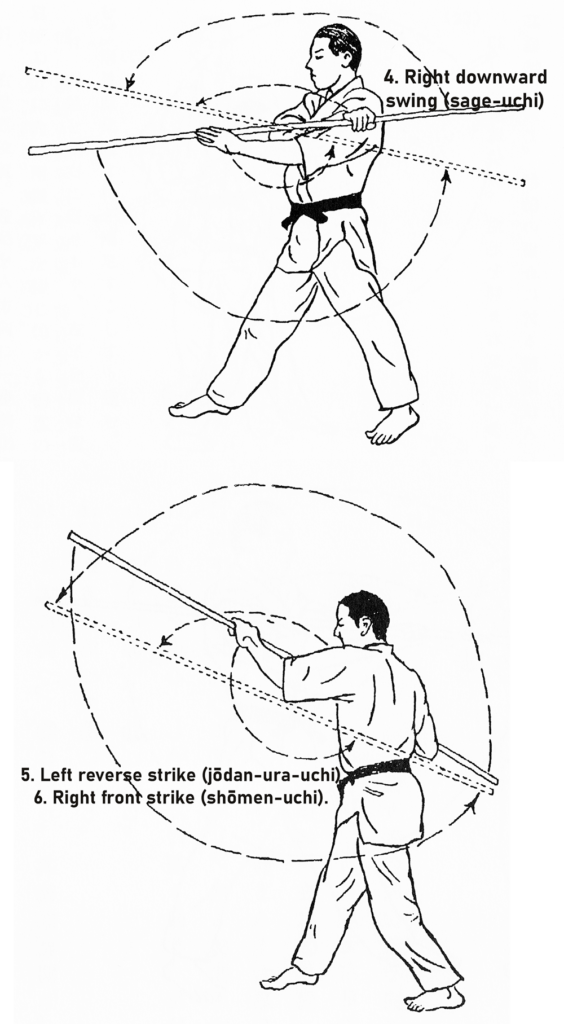
The characteristic combination in old-style Sakugawa no Kon
The description itself is a bit complicated and details every move of the hands and feet, directions, what to do, and what the position of the front and rear of the bō is at the end of technique. I have broken the whole thing down, shortened it to the essentials, and inserted typical Japanese terminology. In this example, the combination is performed with the right leg and hand in front. Of course it’s the same with the left in front, just reversed.
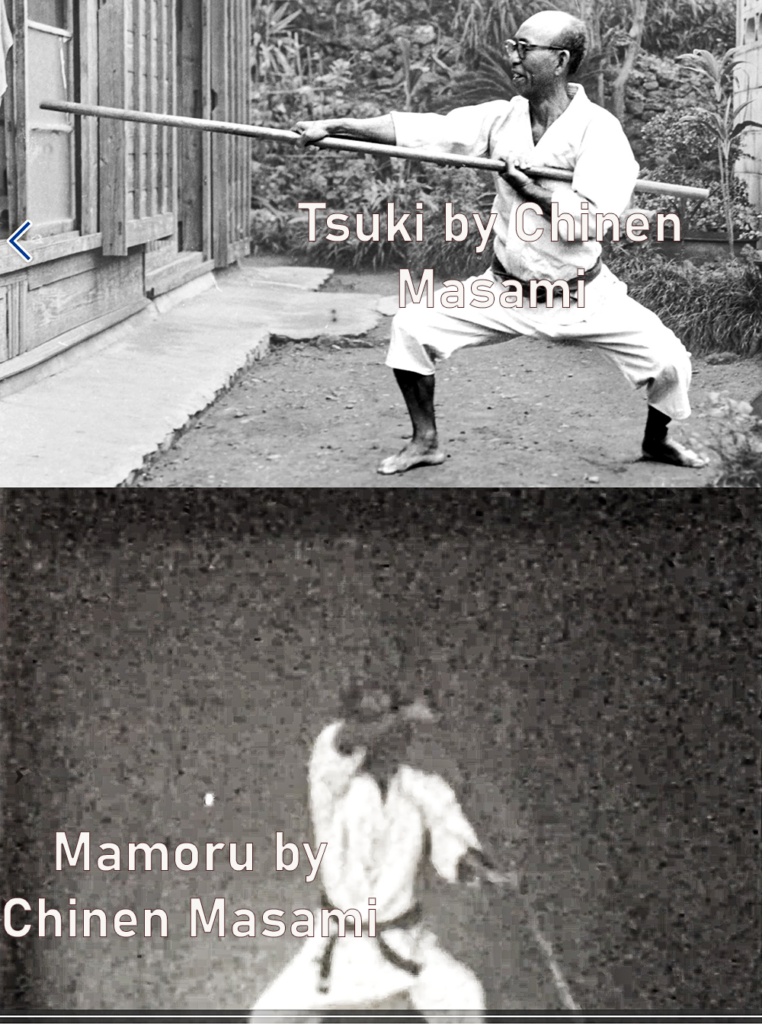
First, here is the order of the techniques, then drawing from Miki’s book, two photos of Chinen Masami performing Sakugawa no Kon for reference, and finally my explanation video.
Defense toward the front (mamoru).
Right front strike (shōmen-uchi).
Left upward swing (furi-age).
Right downward swing (furi-sage)
Left reverse strike (jōdan-ura-uchi)
Right front strike (shōmen-uchi).
Right twisting parry (nejiru).
Right thrust (tsuki).
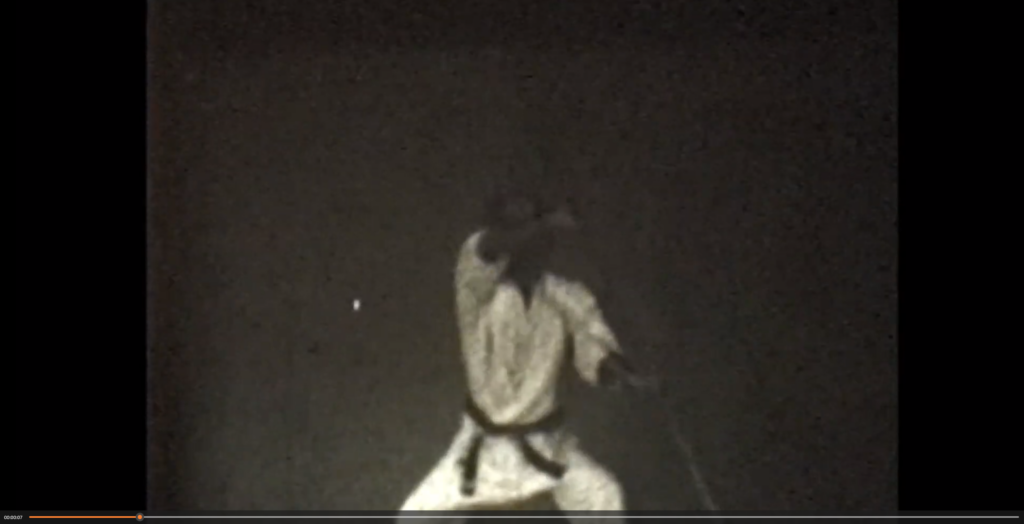
As a comparison of how things looked in a similar lineage, here is tsuki and mamoru by Chinen Masami. Also note his bulky bō.
This is my recinstruction of “Sakugawa no Kon” old-style as described by Miki Jisaburo in 1930, after learning the kata from Oshiro Chojo a year or so earlier.
If you follow closely, it is the same kata and Enbusen as can be seen in Higa Kiyohiko’s version (1970s) and Chinen Masami’s version (1961). The one difference is that this old version here more frequently uses what is simply called “defense” (mamoru) in the old text, and what is otherwise known today as Gedan-barai, Mamori and the like. Higa (1970s) and Chinen (1961) don’t use this technique as often as Oshiro (1930).
The technique called “defense” (mamoru) as performed by Higa (1970s)
The technique called “defense” (mamoru) as performed by Chinen Masami (1961)
Now this “defense” (mamoru) comes in two varieties, but the details are not of interest here. Rather, the point of interest is the question whether there were two almost similar versions of the kata coming from Chinen Sanra (forefather of Yamanni-ryu), or whether Oshiro added these, or whether Chinen abridged the combos. The answer so far is unknown.
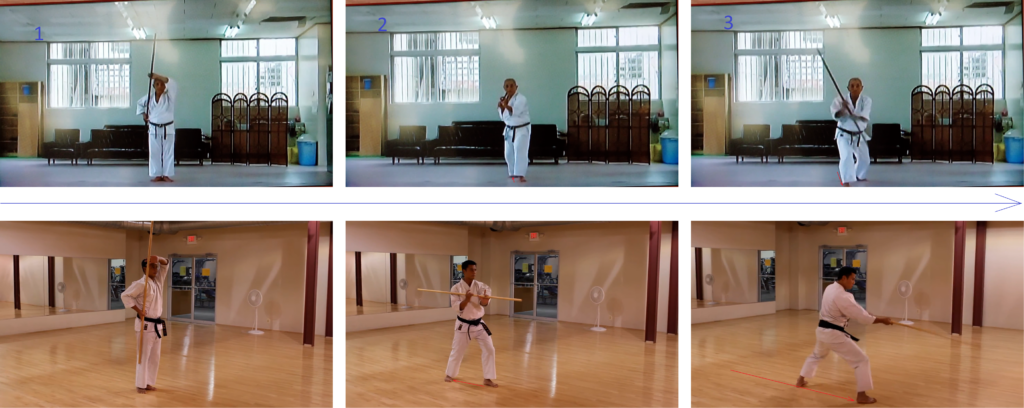
It should also be noted that neither Oshiro (student of Chinen Sanra) nor Higa (student of Chinen Masami), perform the initial step backward into preparation posture before lunging forward with the right foot and the first strike. Also, Yabiku Moden (student of Chinen Sanra) also didn’t teach it to Taira Shinken. And finally in Kakazu, where Chinen Sanra taught during his final year, it is also lacking. And this is true for old-style Shushi no Kon and Sakugawa no Kon.
The initial step backward into preparation posture before lunging forward with the first strike. Photds from video performances of Tamaki Tsuyoshi (upper row) and Len Tran (bottom row).
The logical consequence is that this initial position is a later addition made by Kishaba Chogi, and therefore – including various other things – is a thing of the 1980s onward. As a result, you see it in all the bojutsu of the Kishaba lineage, namely by Nishime Kiyoshi, Oshiro Toshihiro, Shinzato Katsuhiko, Maeda Kiyomasa, Taira Yoshitaka and others. Later on, one Western practitioner even created another offshoot of this initial move, so the development and branching continues.
Well, this initial step makes the start of the kata more dynamic and sensational, but this is not the topic of this short article. This article is just to show how old-style “Sakugawa no Kon” looked, which techniques and enbusen it had. The rest are just observations from my study of various kata and systems and sources over the years. In the end, these are important hints as regards the appearance and evolution of kata and its techniques in the 1st and 2nd halfs of the 20th century.
The origin of Ryūbi no Kon is Shiromatsu no Kon, an older kata handed down in the Matsubayashi-ryū since the 1950s. Its origin further back is unknown, but it is possible that it included older concepts and techniques. It was performed in a rather stiff, basic and unrefined fashion so that progressive martial artists said, “The kata doesn’t work.” Therefore, they developed a yamannized version of it, with more flow and several technical adaptions. To distinguish the two versions, the old one was then named Shiromatsu no Kon Ichi, and the yamannized version was named Shiromatsu no Kon Ni. To further distinguish it, and probably including further updates, it was renamed to Ryūbi no Kon in the RBKD, probably in the 1980s or 90s.
In the description below I had to adapt terminology. This is because, so far in the descriptions of Chōun no Kon of Yamanni-ryū, all front strikes where coherently the same within the respective groups, so I just termed that front strike a Shōmen-uchi, which worked just fine. In this Ryūbi no Kon, however, there are standard front strikes as well as a straight overhead strike, and a straight overhead strike that turns into a tsuki. Therefore, I termed the standard front strike as Kesa-uchi, because it is a slanted strike, and termed the straight overhead strike as Shōmen-uchi, and the straight overhead strike that turns into a thrust as Shōmen-uchi-zuki.
The video is a distorted version of Oshiro Toshihiro’s once published DVD on Yamanni-ryu kata. I used this because I couldn’t locate the original version anymore.
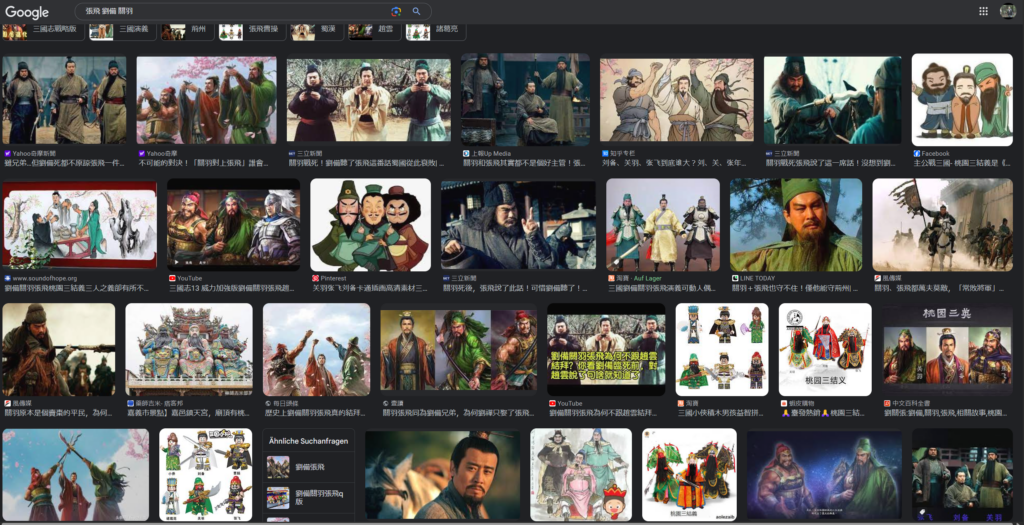
There is an interesting hint to the name of the kata. The original name, Shiromatsu, simply meant “White Pine.” The reformed name, Ryūbi, on the other hand is the Japanaese reading of Liu Bei, military commander from the late Later Han period to the “Era of Three Kingdoms,” and founder and first emperor of the state of Shu Han (221-261) in southern China. Liu Bei appears as a central character in the Ming Dynasty novel “Romance of the Three Kingdoms.”
Liu Bei was the brother in arms of “Tiger Generals” Guan Yu and Zhang Fei. This topic would provide enough content for a PhD thesis, but it should be sufficient to say here that the three are described as sworn brothers in arms who served as role models for others as well. The “Romance of the Three Kingdoms” tells about an oath by other sworn brothers in reference to the three heroes:
“I remember Liu Bei, Guan Yu, and Zhang Fei. Although they have different surnames, they work together as brothers to rescue the poor and help the people in danger; they report to the superiors of the state and help the common people; they do not demand to be born in the same year, the same month and the same day, but they only want to die in the same year, the same month and the same day. Heaven and earth should learn from their spirit.”
Considering the above, if we consider for a moment that Liu Bei might have served as the namesake of Ryūbi no Kon, where and who are the other two sworn brothers? I guess you can come up with a solution yourself.
Description of the Kata
I. Stand in Soto-hachiji-dachi, with both arms hang down naturally at the sides of your body, and the bō in the right hand, with the front tip at about the center line of the body, pointing downward at about 30°.
II. Pull your left foot to your right foot, into Musubi-dachi.
III. Bow to the front. While bowing, the bō remains exactly in the previous position and doesn’t move.
IV. Announce the name of the kata: “Ryūbi no Kon!”
V. Bring your left hand over toward your right hip and grab the bō from below with your left hand. From there, rotate the bō clockwise, take your left hand with the bō to your right shoulder, let go the left hand and place it opened on your right outside thigh. The right arm hangs down naturally, holding the bō vertically, and leaned against the right armpit/shoulder.
VI. Yōi 1. Raise the right hand with the bō vertically up to a position between your right pelvis and right lower rib. At the same time, synchronously, raise your left open hand up in a large clockwise circular motion from the outer side of your right thigh up and over to the left side of your head to again reach the position with the left forearm horizontally in front of your forehead, and grab the bō at the right side of your head.
VII. Yōi 2. Step back with your right foot, assuming a left forward-bent stance (Zenkutsu-dachi). Hold the left tip of the bō to the front, slightly ascending a few degrees, and the rear of the bō placed at your right upper arm close to the shoulder.
Front Lane 1
1. Burst forward with the right foot, with a Kesa-uchi, into a right Shiko-dachi, and immediately pull back the front tip to assume kamae.
2. Shuffle back your right foot and immediately burst forward with your left foot, into a left Shiko-dachi, with Gedan-uke, and immediately follow-through with a Gedan-nuki while sliding forward with both feet in Shiko-dachi.
3. Shuffle back your left foot and immediately burst forward with your right foot, into a left Shiko-dachi, with a Kesa-uchi, into a right Shiko-dachi, and immediately pull back the front tip to assume kamae.
Rear Lane 1
4. Place your right foot a little to the left, and rotate 180° counterclockwise, pull your left foot towards your right foot, in a 45° Musubi-dachi. Raise the bō above your head, tilted about 30° to the front, and 45° to the side, in an upper-level posture.
5. Burst forward with the right foot, with a Kesa-uchi, into a right Zenkutsu-dachi.
6. Change hands and burst forward with the left foot, with a Shōmen-uchi straight from above, into a right Zenkutsu-dachi.
7. Change hands and burst forward with the right foot, with a Shōmen-uchi-zuki straight from above, into a right Zenkutsu-dachi, and immediately assume kamae in Shiko-dachi.
Side Lane 1
8. Rotate 90° counterclockwise, to your left, pull your left foot towards your right foot, in Musubi-dachi. Take the right hand to your right side of your body and the left to the right side of your head, and assume the posture described at the end of number VI. Yōi 1, with the bō held vertically.
9. Place your right foot forward, in a right forward shiko-dachi, and push the bō forward into a slanted vertical defensive posture (tate-kamae). Next, perform the following combination: Right front strike (kesa-uchi), upward swing (furi-age-uchi), downward swing (furi-sage-uchi), front strike (kesa-uchi) with integrated tsuki, and assume kamae in Shiko-dachi.
10. With the bō as it is, pull back the right foot and stand up in a sideways parallel stance (Heiko-dachi).
11. Step the left foot forward into a crossing stance (kōsa-dachi) and simultaneously pull back the bō with your left hand.
12. Burst forward with your right foot, in a right forward Shiko-dachi, thrust to the front, and immediately assume kamae in Shiko-dachi.
Side Lane 2
13. Rotate 180° clockwise, to your rear, and while changing the grip on the bō, pull back your left foot towards your right foot, in Musubi-dachi, and take the bō back to hold it about vertically at the right rear.
14. Place your left foot forward, in a right left shiko-dachi, and push the bō forward into a slanted vertical defensive posture (tate-kamae). Next, perform the same combination as in number 10, but on the left side: Left front strike (kesa-uchi), upward swing (furi-age-uchi), downward swing (furi-sage-uchi), front strike (kesa-uchi) with integrated tsuki, and assume kamae in Shiko-dachi.
15. Perform the same combination as in number 10, but on the left side: With the bō as it is, pull back your left foot and stand up in a sideways parallel stance (Heiko-dachi).
16. Perform the same combination as in number 11, but on the left side: Step the right foot forward into a crossing stance (kōsa-dachi) and simultaneously pull back the bō with your right hand.
17. Perform the same combination as in number 12, but on the left side: Burst forward with your left foot, in a left forward Shiko-dachi, thrust to the front, and immediately assume kamae in Shiko-dachi.
Front Lane 2
18. Perform the same combination as in number 8: Rotate 90° clockwise, to your right, and while changing the grip on the bō, pull your right foot towards your left foot, in Musubi-dachi, and take the bō back to hold it about vertically at the left rear.
19. Perform the same combination as in number 9: Place your right foot forward, in a right forward shiko-dachi, and push the bō forward into a slanted vertical defensive posture (tate-kamae). Next, perform the following combination: Right front strike (kesa-uchi), upward swing (furi-age-uchi), downward swing (furi-sage-uchi), front strike (kesa-uchi) with integrated tsuki, and assume kamae in Shiko-dachi.
20. Swing the bō in a full 360° clockwise around overhead with a gyaku-uchi, ending at the right side of the body, with the bō pointing about 30° downward, and with it, change the position of the feet in a dynamic jump to take the right foot back, and the left foot front, in a forward-bent stance (zenkutsu).
21. Immediately pull up the right foot towards the left foot, into a cross-legged stance (kōsa-dachi), and sing the front end of the bō clockwise around and upwards at the right side of your body, to assume a upper-level floating deflection posture (jōdan nagashi-uke) with the front tip of the bō pointing to the front.
22. Burst forward with your right foot, in a right forward shiko-dachi, and perform the following combination: Right front strike (kesa-uchi), upward swing (furi-age-uchi), downward swing (furi-sage-uchi), front strike (kesa-uchi) with integrated tsuki, and assume kamae in Shiko-dachi.
Finish
I. In a flow of movement, pull back your right foot to your left foot, in Musubi-dachi, and lead the bō almost vertically from your left rear to your right front, to assume the initial posture of the kata (as described at the end of number VI. Yōi 1), with the right hand holding the bō vertically at a position between your right pelvis and right lower rib, and your left at about the right side of your head.
II. Rotate the front (right) tip of the bō counterclockwise, take your right hand down at your right side, and your left hand under the armpit.
III. Let go the left hand, and let both arms hang down naturally at the sides of your body.
IV. Bow to the front.
V. Step your left foot out to the left, into Soto-hachiji-dachi.
As in the previous installments, I am looking at versions of the Choun no Kon of Yamanni-ryu. This time it is the version by Tamaki Tsuyoshi, a direct student of Kishaba Chogi (1st generation of Kishaba-ha Yamanni-ryu). Watch his Chōun no Kon (Ichi) below.
When compared to Choun no Kon Sho and Choun no Kon Dai previously described, there are a number of differences to note. First of all, the suffix Ni and Dai are just preferences; they mean the same kata. As already mentioned here, the beginning and ending of Tamaki’s performance is less formalized and less dramatic than the other version, and also Tamaki takes each step without shuffling. Then, Tamaki’s tsuki are short sliding thrusts while bursting in with both feet, while the other version does a regular long tsuki. In the upward / downward swing combo, Tamaki shortly assumes Musubi-dachi, placing emphasis on the downward swing (furi-sage), which is unseen in the other version.
The most striking differences however is the following.
in Lane 1, Choun no Kon Sho does the combination Shōmen-uchi / Gedan-uke / Gedan-nuki only once. Tamaki’s Choun no Kon Ichi, which should be the same, does it twice.
Then, Choun no Kon Dai does that same combination only once, while Tamaki’s Choun no Kon Ni does it only once.
In short, both kata are different in this regard, but between the two different versions of Yamanni-ryu, it is twisted on top of it. This is also of interest when I will be looking at other Kishaba lineage versions in the future. With such hints you can not only identify who might have learned from whom personally, but if in doubt you may also retrace who studied a kata from which person’s or association’s video. Such morphological details become more and more important in questions of authenticity.
I. Stand in Musubi-dachi facing to the front. Hold the bō with the right hand and under your right armpit.
II. Rotate the bō counterclockwise, take hold of it with your left hand as well, and use the left hand to place it at your right shoulder/ armpit. Place the left open hand at the outside of your right thigh, and your right hand holding the bō vertically at the right side of the body, with your right arm hanging down naturally.
III. Bow to the front. While bowing, the bō moves with the upper body.
IV. Yōi 1. Raise the right hand with the bō vertically up to a position between your right pelvis and right lower rib. At the same time, synchronously, raise your left open hand up in a large clockwise circular motion from the outer side of your right thigh up and over to the left side of your head to again reach the position with the left forearm horizontally in front of your forehead, and grab the bō at the right side of your head.
VII. Yōi 2. Step back with your right foot little, in a short rear-bent stance (kōkutsu), assuming a left forward stance. Hold the left tip of the bō to the front, slightly ascending a few degrees, and the rear of the bō placed at your right upper arm close to the elbow.
Front Lane 1
1. Burst forward with the right foot, with a Shōmen-uchi, into a right Shiko-dachi, and immediately pull back the front tip to assume kamae.
2. Burst forward with the left foot, into a left short rear-bent stance (kōkutsu), with Gedan-uke, and immediately follow-through with a Gedan-nuki.
3. Burst forward with the right foot, with a Shōmen-uchi, into a right Shiko-dachi, and immediately pull back the front tip to assume kamae.
Side Lane 1
4. With the right foot as the pivot, rotate 90° to your left, and place your left foot backward in absolute direction right, in a short right forward-bent stance (zenkutsu) toward absolute direction left. Perform the following combination: Right front strike twice in a row (shōmen-uchi 2x), pull left foot back into Musubi-dachi with upward swing (furi-age-uchi), downward swing (furi-sage-uchi), burst forward with your left foot into short Shizen-dachi with a right front strike (shōmen-uchi), burst in forward with both your feet into Shiko-dachi with a mid-level thrust, and finally assume kamae.
Side Lane 2
5. With your right foot as the pivot, rotate 180° counterclockwise, and place your left foot backward, in absolute direction left, in a short right forward-bent stance (zenkutsu) toward absolute direction right. Perform the same combination as in number 4: Right front strike twice in a row (shōmen-uchi 2x), pull left foot back into Musubi-dachi with upward swing (furi-age-uchi), downward swing (furi-sage-uchi), burst forward with your left foot into short Shizen-dachi with a right front strike (shōmen-uchi), burst in forward with both your feet into Shiko-dachi with a mid-level thrust, and finally assume kamae.
Front Lane 2
6. With your left foot as the pivot, rotate 90° counterclockwise, and place your right foot forward, in absolute direction front, in a short right forward-bent stance (zenkutsu). Perform the same combination as in numbers 4 and 6: Right front strike twice in a row (shōmen-uchi 2x), pull left foot back into Musubi-dachi with upward swing (furi-age-uchi), downward swing (furi-sage-uchi), burst forward with your left foot into short Shizen-dachi with a right front strike (shōmen-uchi), burst in forward with both your feet into Shiko-dachi with a mid-level thrust, and finally assume kamae.
Rear Lane 1
7. With your right foot as the pivot, rotate 180° counterclockwise, and place your left foot backward, in absolute direction front, in a short right forward-bent stance (zenkutsu). Perform the same combination as in numbers 4, 5, and 6: Right front strike twice in a row (shōmen-uchi 2x), pull left foot back into Musubi-dachi with upward swing (furi-age-uchi), downward swing (furi-sage-uchi), burst forward with your left foot into short Shizen-dachi with a right front strike (shōmen-uchi), burst in forward with both your feet into Shiko-dachi with a mid-level thrust, and finally assume kamae.
8. Burst forward with the left foot, into a left short rear-bent stance (kōkutsu), with Gedan-uke.
9. Burst a full right step forward, with a Shōmen-uchi, into a right forward-bent stance (zenkutsu).
10. Burst a full left step forward, with a Shōmen-uchi, into a left forward-bent stance (zenkutsu).
11. Burst a full right step forward, with a right age-uchi, in a short right forward-bent stance (zenkutsu) or natural stance (kōkutsu), follow through with a right Shōmen-uchi, and immediately assume kamae in Shiko-dachi.
Front Lane 3
12. With your right foot as the pivot, rotate 180° counterclockwise, and place your left foot backward, in absolute direction rear, in a right forward natural stance (hanmi shizen-dachi). Perform a right front strike twice in a row (shōmen-uchi 2x), burst in forward with both your feet into Shiko-dachi with a mid-level thrust, and finally assume kamae.
Finish
I. In a flow of movement, take your left hand to your left ear and your right hand in front of your right chest, then pull back your right foot to your left foot, in Musubi-dachi, and assume the initial posture of the kata (as described at the end of number VI. Yōi 1), with the bō held vertically at a position between your right pelvis and right lower rib.
II. In a large clockwise circular motion from the left side of your head over and down, place your left open hand at the outside of your right thigh, and lower your right hand holding the bō vertically at the right side of the body, so that both your arms hanging down naturally.
III. Rotate the bō counterclockwise, bring it under your armpit and hold it with your right hand.
As in the previous installments, I am looking at versions of the Choun no Kon of Yamanni-ryu. This time it is the version by Tamaki Tsuyoshi, a direct student of Kishaba Chogi (1st generation of Kishaba-ha Yamanni-ryu). Watch his Chōun no Kon (Ichi) below.
There are a few differences when compared to the Chōun no Kon Shō I described earlier. First of all, the suffix Ichi and Sho are just preferences; they mean the same kata. Most notably, the beginning and ending of Tamaki’s performance is less formalized and less dramatic than the other version, which I concluded must be the RBKD version under senseis Ōshiro Toshihiro and / or Nishime Kiyoshi. Next, the stances and foot changes differ variously. For instance, while the other (RBKD) version uses a lot of shuffling feet, Tamaki takes a full step every time. Also, what is a forward-bent stance in the other (RBKD) version, is a short rearward-bent stance in case of Tamaki. Also, Tamaki repeats techniques 1. and 2., while the other (RBKD) version only performs 1. and 2. once, but that might have been a modification for performance on their part.
I. Stand in Musubi-dachi facing to the front. Hold the bō with the right hand and under your right armpit.
II. Rotate the bō counterclockwise, take hold of it with your left hand as well, and use the left hand to place it at your right shoulder/ armpit. Place the left open hand at the outside of your right thigh, and your right hand holding the bō vertically at the right side of the body, with your right arm hanging down naturally.
III. Bow to the front. While bowing, the bō moves with the upper body.
IV. Yōi 1. Raise the right hand with the bō vertically up to a position between your right pelvis and right lower rib. At the same time, synchronously, raise your left open hand up in a large clockwise circular motion from the outer side of your right thigh up and over to the left side of your head to again reach the position with the left forearm horizontally in front of your forehead, and grab the bō at the right side of your head.
VII. Yōi 2. Step back with your right foot little, in a short rear-bent stance (kōkutsu), assuming a left forward stance. Hold the left tip of the bō to the front, slightly ascending a few degrees, and the rear of the bō placed at your right upper arm close to the elbow.
Front Lane 1
1. Burst forward with the right foot, with a Shōmen-uchi, into a right Shiko-dachi, and immediately pull back the front tip to assume kamae.
2. Burst forward with the left foot, into a left short rear-bent stance (kōkutsu), with Gedan-uke, and immediately follow-through with a Gedan-nuki.
3. Same as 1.
4. Same as 2.
5. Same as 1. and 3.
Side Lane 1
6. Rotate 90° counterclockwise, to your left, pull your left foot towards your right foot and place the left foot forward in absolute direction left, in a in left short rear-bent stance (kōkutsu). Simultaneously, change the grip on the bō and perform a left vertical defense (tate-uke). Perform the following combination: Left front strike (shōmen-uchi), pull left foot back into Musubi-dachi with upward swing (furi-age-uchi), downward swing (furi-sage-uchi), burst forward with your left foot into Shiko-dachi with a right front strike (shōmen-uchi), and finally assume kamae.
Side Lane 2
7. Rotate 180° clockwise, to your rear, in absolute direction right, in a short rear-bent stance (kōkutsu). Simultaneously, change the grip on the bō and perform a right vertical defense (tate-uke). Perform the same combination as in number 4., just on the right side: Right front strike (shōmen-uchi), pull right foot back into Musubi-dachi with upward swing (furi-age-uchi), downward swing (furi-sage-uchi), burst forward with your right foot into Shiko-dachi with a right front strike (shōmen-uchi), and finally assume kamae.
Front Lane 2
8. With your right foot in place, rotate 90° counterclockwise, to absolute direction front, and place your left foot forward, into a left short rear-bent stance (kōkutsu), with Gedan-uke, and immediately follow-through with a Gedan-nuki.
9. Burst forward with the right foot, with a Shōmen-uchi, into a right Shiko-dachi, and immediately pull back the front tip to assume kamae.
Rear Lane 1
10. With the right foot as the pivot, rotate 180° clockwise, to your rear, in absolute direction rear, and place your left foot backward, in a cross-legged stance (kōsa-dachi). Perform a knocking strike to the lower level (gedan tataki-uchi) and immediately burst forward with the right foot, in a right shiko-dachi with a right front strike (Shōmen-uchi), and immediately pull back the front tip to assume kamae.
11. In a flow of movement, take your left hand to your left ear and your right hand in front of your right chest, then pull back your right foot to your left foot, in Musubi-dachi, and assume the initial posture of the kata (as described at the end of number VI. Yōi 1).
12. Burst forward with the left foot, into a left short rear-bent stance (kōkutsu), with Gedan-uke, and immediately follow-through with a Gedan-nuki.
13. Burst forward with the right foot, with a Shōmen-uchi, into a right Shiko-dachi, and immediately pull back the front tip to assume kamae.
14. Burst forward with the left foot, into a left short rear-bent stance (kōkutsu), with Gedan-uke, and immediately follow-through with a Gedan-nuki.
15. Burst forward with the right foot, with a Shōmen-uchi, into a right Shiko-dachi, and immediately pull back the front tip to assume kamae.
Front Lane 3
16. With the right foot as the pivot, rotate 180° clockwise, to your rear, in absolute direction front, and place your left foot backward, in a cross-legged stance (kōsa-dachi). Perform a knocking strike to the lower level (gedan tataki-uchi) and immediately burst forward with the right foot, in a right shiko-dachi with a right front strike (Shōmen-uchi), and immediately pull back the front tip to assume kamae.
Finish
I. In a flow of movement, take your left hand to your left ear and your right hand in front of your right chest, then pull back your right foot to your left foot, in Musubi-dachi, and assume the initial posture of the kata (as described at the end of number VI. Yōi 1), with the bō held vertically at a position between your right pelvis and right lower rib.
II. In a large clockwise circular motion from the left side of your head over and down, place your left open hand at the outside of your right thigh, and lower your right hand holding the bō vertically at the right side of the body, so that both your arms hanging down naturally.
III. Rotate the bō counterclockwise, bring it under your armpit and hold it with your right hand.
Previously, I wrote about Choun no Kon Dai, the general introduction of which applies here as well. This however is the Sho version as performed in the following video by Heiwa Karate Hawaii.
As previously, I have studied the kata and created the description of the kata you’ll find below, and here is also my copy cat performance. Again I used standard terminology since I am not initiated to the special terminology used in Yamanni-ryu.
Description of the Kata
I. Stand in Musubi-dachi facing to the front. Hold the bō in your right hand, with your right arm hanging down naturally, and the bō tilted downward to the front at about 30°.
II. Bow to the front. While bowing, the bō remains exactly in the previous position and doesn’t move.
III. Announce the name of the kata: “Chōun no Kon Dai!”
IV. Bring your right hand over toward your left hip, and with the bō held horizontally, grip the bō from below with your left hand. Your right hand is on top, and your left hand is below, thus crossing both hands.
V. Once you have gripped with both hands as described in number 4, step forward with your right foot, and immediately follow up with your left foot, to stand in Musubi-dachi again. While doing so, continue to rotate the bō clockwise, take your left arm up with the upper arm vertically at the left side of the head, the left elbow at a right angle, the left forearm horizontally in front of your forehead, and the left hand holding the bō at the side of the left temple. The right hand holds the bō at the right side of the body, with your right arm hanging down naturally. Let go the left hand and support the bō in the previous position, with your right hand and leaned against your right shoulder/armpit. Move the left hand in a large counterclockwise circular motion from the right side of your head up and over to the left side and down to the outer side of your left thigh.
VI. Yōi 1. Raise the right hand with the bō vertically up to a position between your right pelvis and right lower rib. At the same time, synchronously, raise your left open hand up in a large clockwise circular motion from the outer side of your right thigh up and over to the left side of your head to again reach the position with the left forearm horizontally in front of your forehead, and grab the bō at the right side of your head.
VII. Yōi 2. Step back with your right foot, assuming a left forward-bent stance (Zenkutsu-dachi). Hold the left tip of the bō to the front, slightly ascending a few degrees, and the rear of the bō placed at your right upper arm close to the elbow.
Front Lane 1
1. Burst forward with the right foot, with a Shōmen-uchi, into a right Shiko-dachi, and immediately pull back the front tip to assume kamae.
2. Burst forward with the left foot while simultaneously shuffling back your right foot, into a left Shiko-dachi, with Gedan-uke, and immediately follow-through with a Gedan-nuki.
3. Take a full step forward (without shuffle), with a Shōmen-uchi, into a right Shiko-dachi.
Side Lane 1
4. Turn 90° counterclockwise, to your left, pull your right foot towards your left foot and place the left foot forward in absolute direction left, in a left forward shiko-dachi. Simultaneously, change the grip on the bō and perform a vertical defense (tate-uke). Perform the following combination: Left front strike (shōmen-uchi), upward swing (furi-age-uchi), downward swing (furi-sage-uchi), front strike (shōmen-uchi), and finally assume kamae.
Side Lane 2
5. Turn 180° clockwise, to your rear, in absolute direction right, in a right forward shiko-dachi. Simultaneously, change the grip on the bō and perform a vertical defense (tate-uke). Perform the following combination: Right front strike (shōmen-uchi), upward swing (furi-age-uchi), downward swing (furi-sage-uchi), front strike (shōmen-uchi), and finally assume kamae.
Front Lane 2
6. With your right foot in place, turn 90° counterclockwise, to absolute direction front, and burst forward with your left foot, into a left Shiko-dachi, with Gedan-uke, and immediately follow-through with a Gedan-nuki.
7. Burst forward with the right foot while simultaneously shuffling back your left foot, into a right forward Shiko-dachi, with a right Shōmen-uchi, and immediately pull back the front tip to assume kamae.
Rear Lane 1
8. With the right foot as the pivot, turn 180° clockwise, to your rear, in absolute direction rear, and place your left foot backward, in a right forward natural stance (hanmi shizen-dachi). Perform a knocking strike to the lower level (gedan tataki-uchi) and immediately burst forward with the right foot, in a right shiko-dachi with a right Shōmen-uchi, and immediately pull back the front tip to assume kamae.
9. Take your left hand to your left ear and your right hand in front of your right chest, so that the bō is positioned about 45° toward absolute direction left.
10. Pull back your right foot to your left foot, in Musubi-dachi, and assume the initial posture of the kata (as described at the end of number VI. Yōi 1).
11. Burst forward with the left foot, into a left Shiko-dachi, with Gedan-uke, and immediately follow-through with a Gedan-nuki.
12. Take a full right step forward (without shuffle), with a Shōmen-uchi, into a right Shiko-dachi, and immediately pull back the front tip to assume kamae.
13. Burst forward with the left foot while simultaneously shuffling back your right foot, into a left Shiko-dachi, with Gedan-uke, and immediately follow-through with a Gedan-nuki.
14. Take a full right step forward (without shuffle), with a Shōmen-uchi, into a right Shiko-dachi, and immediately pull back the front tip to assume kamae.
Front Lane 3
15. With the right foot as the pivot, turn 180° clockwise, to your rear, in absolute direction front, and place your left foot backward, in a right forward natural stance (hanmi shizen-dachi). Perform a knocking strike to the lower level (gedan tataki-uchi) and immediately burst forward with the right foot, in a right shiko-dachi with a right Shōmen-uchi, and immediately pull back the front tip to assume kamae.
Finish
I. Take your left hand to your left ear and your right hand in front of your right chest, so that the bō is positioned about 45° toward absolute direction left.
II. Draw back your right foot to your left foot, into Musubi-dachi, and assume the initial position of the bō: Take your left arm up with the upper arm vertically at the left side of the head, the left elbow at a right angle, the left forearm horizontally in front of your forehead, and the left hand holding the bō at the side of the left temple. The right hand holds the bō at the right side of the body, the right hand with the bō held vertically at a position between your right pelvis and right lower rib.
III. Step back with your right foot, and immediately draw back your left foot and attach it to your right foot to stand in Musubi-dachi facing to the front. Simultaneously, rotate the bō counterclockwise until your left hand is under your right armpit, and your right hand down and forward at about 30°. Place your left open hand on your left thigh, and hold the bō in your right hand, with your right arm hanging down naturally, and the bō tilted down and forward at about 30°.
IV. Bow to the front. While bowing, the bō remains exactly in the previous position and doesn’t move.
Arguably, Yamanni-ryu might be the most widely practiced style around the world. There are many different versions of it, each with specific habits. For instance, today I took a version from a YouTube video by a Hawaiian group who train Shito-ryu and Yamanni-ryu. When analyzing the kata, it turned out that the preparation from the initial position to the position just before the first technique is a “kata” of 7 phases itself, including two Yōi positions (body at the position of attention). This very specific order and habit of operation points to the RBKD as the origin of this version of the kata, namely the Kishaba lineage Yamanni-ryu under senseis Ōshiro Toshihiro and Nishime Kiyoshi.
Obviously, this depends on how you count, but morphologically dissecting it, this is my result. I am not a practitioner of the school although I had basic initiations over the years, so don’t judge me. I also only have limited space in my tiny multifunctial dojo. For me, it is more the choreography or how kata are designed that is of interest.
With that approach, some tight analysis with a written description, and some hard work, you could learn most kata from video. It is just fun. In this case, analyzing each phase and writing it down in order including notes took longer than performing the kata at the end. The analysis took one hour. Running the kata took 5 minutes. It was exactly three tries. Watch the result here.
Description of the Kata
I. Stand in Musubi-dachi facing to the front. Hold the bō in your right hand, with your right arm hanging down naturally, and the bō tilted downward to the front at about 30°.
II. Bow to the front. While bowing, the bō remains exactly in the previous position and doesn’t move.
III. Announce the name of the kata: “Chōun no Kon Dai!”
IV. Bring your right hand over toward your left hip, and with the bō held horizontally, grip the bō from below with your left hand. Your right hand is on top, and your left hand is below, thus crossing both hands.
V. Once you have gripped with both hands as described in number 4, step forward with your right foot, and immediately follow up with your left foot, to stand in Musubi-dachi again. While doing so, continue to rotate the bō clockwise, take your left arm up with the upper arm vertically at the left side of the head, the left elbow at a right angle, the left forearm horizontally in front of your forehead, and the left hand holding the bō at the side of the left temple. The right hand holds the bō at the right side of the body, with your right arm hanging down naturally. Let go the left hand and support the bō in the previous position, with your right hand and leaned against your right shoulder/armpit. Move the left hand in a large counterclockwise circular motion from the right side of your head up and over to the left side and down to the outer side of your left thigh.
VI. Yōi 1. Raise the right hand with the bō vertically up to a position between your right pelvis and right lower rib. At the same time, synchronously, raise your left open hand up in a large clockwise circular motion from the outer side of your right thigh up and over to the left side of your head to again reach the position with the left forearm horizontally in front of your forehead, and grab the bō at the right side of your head.
VII. Yōi 2. Step back with your right foot, assuming a left forward-bent stance (Zenkutsu-dachi). Hold the left tip of the bō to the front, slightly ascending a few degrees, and the rear of the bō placed at your right upper arm close to the elbow.
Front Lane 1
1. Burst forward with the right foot, with a Shōmen-uchi, into a right Shiko-dachi, and immediately pull back the front tip to assume kamae.
2. Burst forward with the left foot while simultaneously shuffle back your right foot, into a left Shiko-dachi, with Gedan-uke, and immediately follow-through with a Gedan-nuki.
3. Same as 1.
4. Same as 2.
5. Take a full step forward (without shuffle), with a Shōmen-uchi, into a right Shiko-dachi,
Side Lane 1
6. Turn 90° to your left, and place your left foot backward in absolute direction right, in a right forward-bent stance (zenkutsu) toward absolute direction left. Perform the following combination: Right front strike twice in a row (shōmen-uchi 2x), upward swing (furi-age-uchi), downward swing (furi-sage-uchi), front strike (shōmen-uchi), pull back front leg and bō and burst forward again with a right thrust (tsuki), and finally assume kamae.
Side Lane 2
7. With your right foot as the pivot, rotate 180° counterclockwise, and place your left foot backward, in absolute direction left, in a right forward-bent stance (zenkutsu) toward absolute direction right. Perform the same combination as in number 6 (Right front strike twice in a row (shōmen-uchi 2x), upward swing (furi-age-uchi), downward swing (furi-sage-uchi), front strike (shōmen-uchi), pull back front leg and bō and burst forward again with a right thrust (tsuki), and finally assume kamae).
Front Lane 2
8. With your right foot as the pivot, rotate 90° counterclockwise, and place your left foot backward, in absolute direction rear, in a right forward-bent stance (zenkutsu). Perform the same combination as in number 6 and 7 (Right front strike twice in a row (shōmen-uchi 2x), upward swing (furi-age-uchi), downward swing (furi-sage-uchi), front strike (shōmen-uchi), pull back front leg and bō and burst forward again with a right thrust (tsuki), and finally assume kamae).
Rear Lane 1
9. With your right foot as the pivot, rotate 180° counterclockwise, and place your left foot backward, in absolute direction front, in a right forward-bent stance (zenkutsu). Perform the same combination as in number 6, 7, and 8 (Right front strike twice in a row (shōmen-uchi 2x), upward swing (furi-age-uchi), downward swing (furi-sage-uchi), front strike (shōmen-uchi), pull back front leg and bō and burst forward again with a right thrust (tsuki), and finally assume kamae).
10. Burst forward with the left foot while simultaneously shuffle back your right foot, into a left Shiko-dachi, with Gedan-uke.
11. Take a full right step forward (without shuffle), with a Shōmen-uchi, into a right forward-bent stance (zenkutsu).
12. Take a full left step forward (without shuffle), with a Shōmen-uchi, into a left forward-bent stance (zenkutsu).
13. Take a full right step forward (without shuffle), with a right yoko-uchi or age-uchi, in a right forward-bent stance (zenkutsu), follow through with a right Shōmen-uchi, and immediately assume kamae in Shiko-dachi.
Front Lane 3
14. With your right foot as the pivot, rotate 180° counterclockwise, and place your left foot backward, in absolute direction rear, in a right forward natural stance (hanmi shizen-dachi). Perform a right front strike twice in a row (shōmen-uchi 2x), pull back front leg and bō and burst forward again with a right thrust (tsuki), and finally assume kamae.
Finish
I. Take your left hand to your left ear and your right hand in front of your right chest, so that the bō is positioned about 45° toward absolute direction left.
II. Draw back your right foot to your left foot, into Musubi-dachi, and assume the initial position of the bō: Take your left arm up with the upper arm vertically at the left side of the head, the left elbow at a right angle, the left forearm horizontally in front of your forehead, and the left hand holding the bō at the side of the left temple. The right hand holds the bō at the right side of the body, the right hand with the bō held vertically at a position between your right pelvis and right lower rib.
III. Step back with your right foot, and immediately draw back your left foot and attach it to your right foot to stand in Musubi-dachi facing to the front. Simultaneously, rotate the bō counterclockwise until your left hand is under your right armpit, and your right hand down and forward at about 30°. Place your left open hand on your left thigh, and hold the bō in your right hand, with your right arm hanging down naturally, and the bō tilted down and forward at about 30°.
IV. Bow to the front. While bowing, the bō remains exactly in the previous position and doesn’t move.
Afternote
In above description I used standard terminology. The channel I took the video from to learn it however offers some technical terms, saying that Chōun no Kon Dai uses “Saburi-zuki (furi-zuki)” [do they mean suburi-zuki?] or “swinging thrusts,” strikes to the leg immediately followed by “traditional kesa-uchi” (diagonal strike). They also add that the kata has been “modified for performance.”
Terms like “traditional kesa-uchi” are of interest, since kesa-uchi is a term from obviously adopted from other Japanese martial arts, and is not an “old Okinawan name” or anything.
Likewise, as regards the name “Choun no Kon,” the channel states “The versions of Choun no Kon belonging to the Taira and Matayoshi schools of Okinawan kobudo are unrelated.” Well, that’s right. For instance, “Choun no Kon” was performed by Yabiku Moden in 1923 already, and later became “Taira lineage.”
Choun no Kon of Yamanni-ryu on the other hand is a modern creation, probably to train basic concepts of the school. I felt I need to add this to prevent misunderstandings. Choun no Kon of Taira lineage is really a kata of the kingdom era, while Choun no Kon of Yamanni-ryu is of the 1980s or so. Ok, that was all.
Looking at the last technique of Shirotaru no Kon, there are various ways it is done, depending on the lineage. In the lineage of Izumikawa Kantoku to Kyan Shin’ei as well as to Iha Kotaro, the last technique is an upward move followed by a downward press with levered hands. A move very close to can be seen in a technique of Tendo-ryu naginata from a 1947 footage.
Now, you may find all sorts of comparable techniques, however, the reason why Tendo-ryu naginata is of interest is that it is among the handful of styles that are proven to have existed and been trained in Okinawa since the 17th century. If you want to know more about it, read our work “Okinawan Samurai” to get all the details once and for all.
I have cut the following short video to show you the technique in question.
Shirotaru no Kon – Izumikawa Kantoku lineage – Last technique
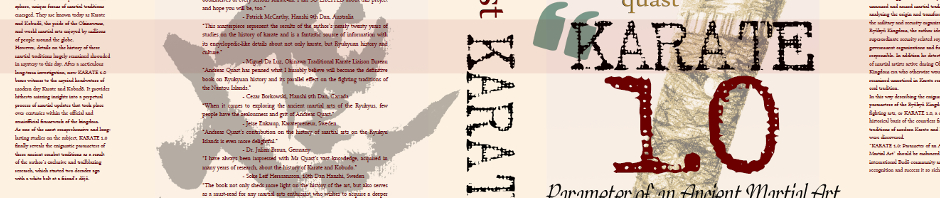
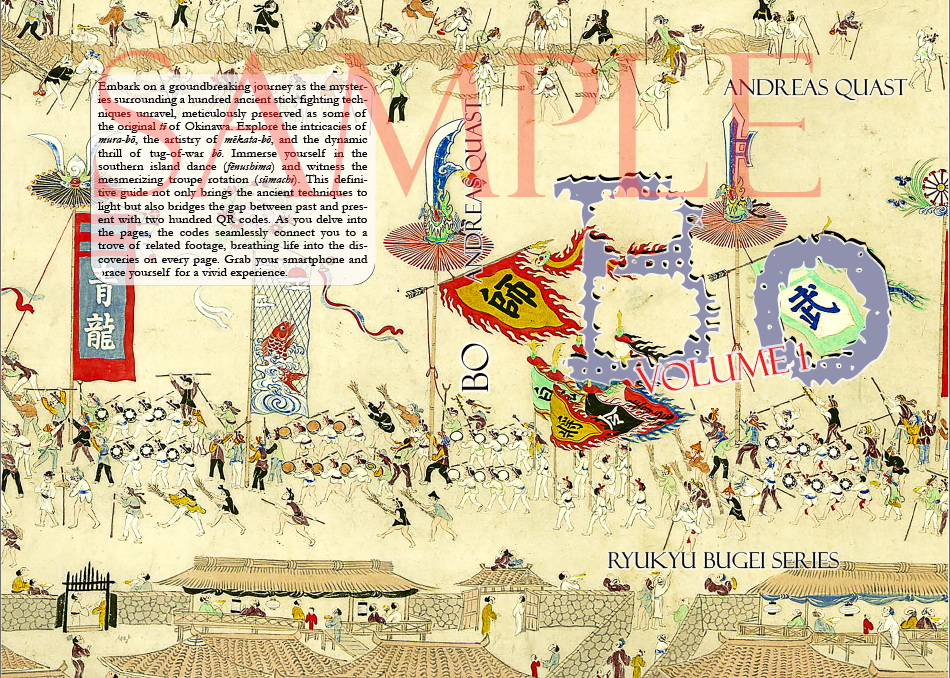
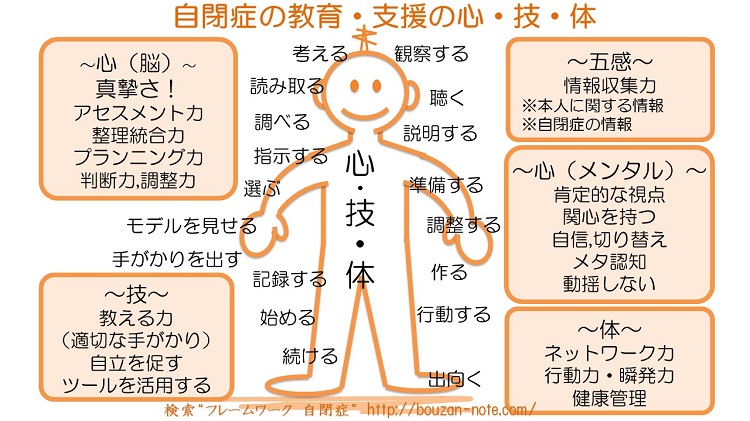
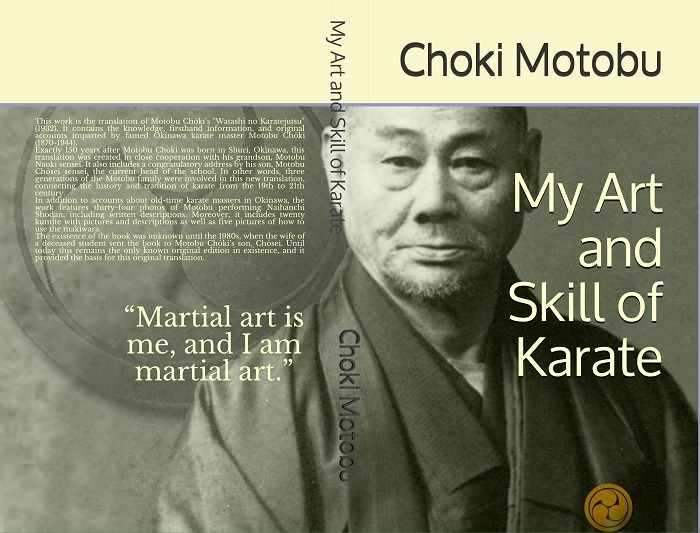
 Troubled about the future of his only son and heir, a royal government official of the Ryukyu Kingdom wrote down his ‘Instructions’ as a code of practice for all affairs. Written in flowing, elegant Japanese, he refers to a wide spectrum of artistic accomplishments that the royal government officials were ought to study in those days, such as court etiquette, literature and poetry, music, calligraphy, the tea ceremony and so on.
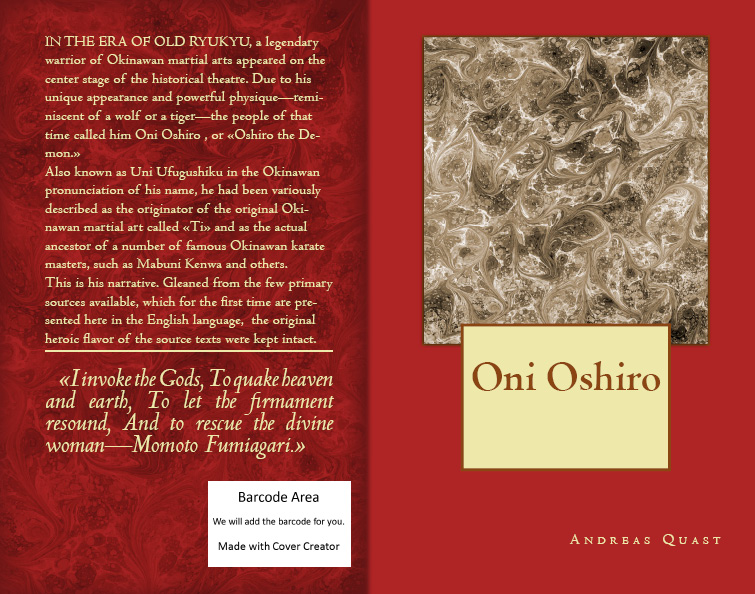 In the era of Old Ryukyu, a legendary warrior of Okinawan martial arts appeared on the center stage of the historical theatre. Due to his unique appearance and powerful physique—reminiscent of a wolf or a tiger—the people of that time called him Oni Ōshiro, or «Ōshiro the Demon.»